Every failed delivery costs a D2C brand twice: once in shipping and once in a customer who may never order again. Here is how to find the causes, fix them step by step, and turn delivery into a reason customers come back.
For a D2C brand, delivery is the moment of truth. You have paid to acquire the customer, built the product, packed the order and shipped it. If the delivery fails, none of that matters. The customer is annoyed, the parcel returns, and the money spent on acquiring that order is gone.
The good news is that most failed deliveries are preventable. This guide explains what causes them, how D2C brands can reduce failed deliveries with practical fixes, and how a better delivery experience improves repeat purchases and reviews.
What counts as a failed delivery?
A failed delivery is any order that is not handed over successfully on the first attempt. In practice it shows up in several ways:
- Customer unavailable: nobody to receive the order, or the phone is not answered
- Wrong or incomplete address: missing landmark, wrong pincode or unreachable location
- Refused delivery: often on cash on delivery orders, when the buyer changes their mind
- Rider-side failures: rider unavailable, order rescheduled, or delivery attempted outside the promised window
- Damaged or tampered parcels: orders the customer will not accept
- Return to origin (RTO): the parcel comes back to you after unsuccessful attempts
Why failed deliveries hurt D2C brands more
Marketplaces can absorb some failure. D2C brands usually cannot, because every order carries a direct acquisition cost. Failed deliveries hurt in four ways:
- Double logistics cost: you pay for the forward trip and often the return
- Wasted acquisition spend: the ad money behind that order produces nothing
- Inventory stuck in transit: stock is unavailable for other buyers until it comes back
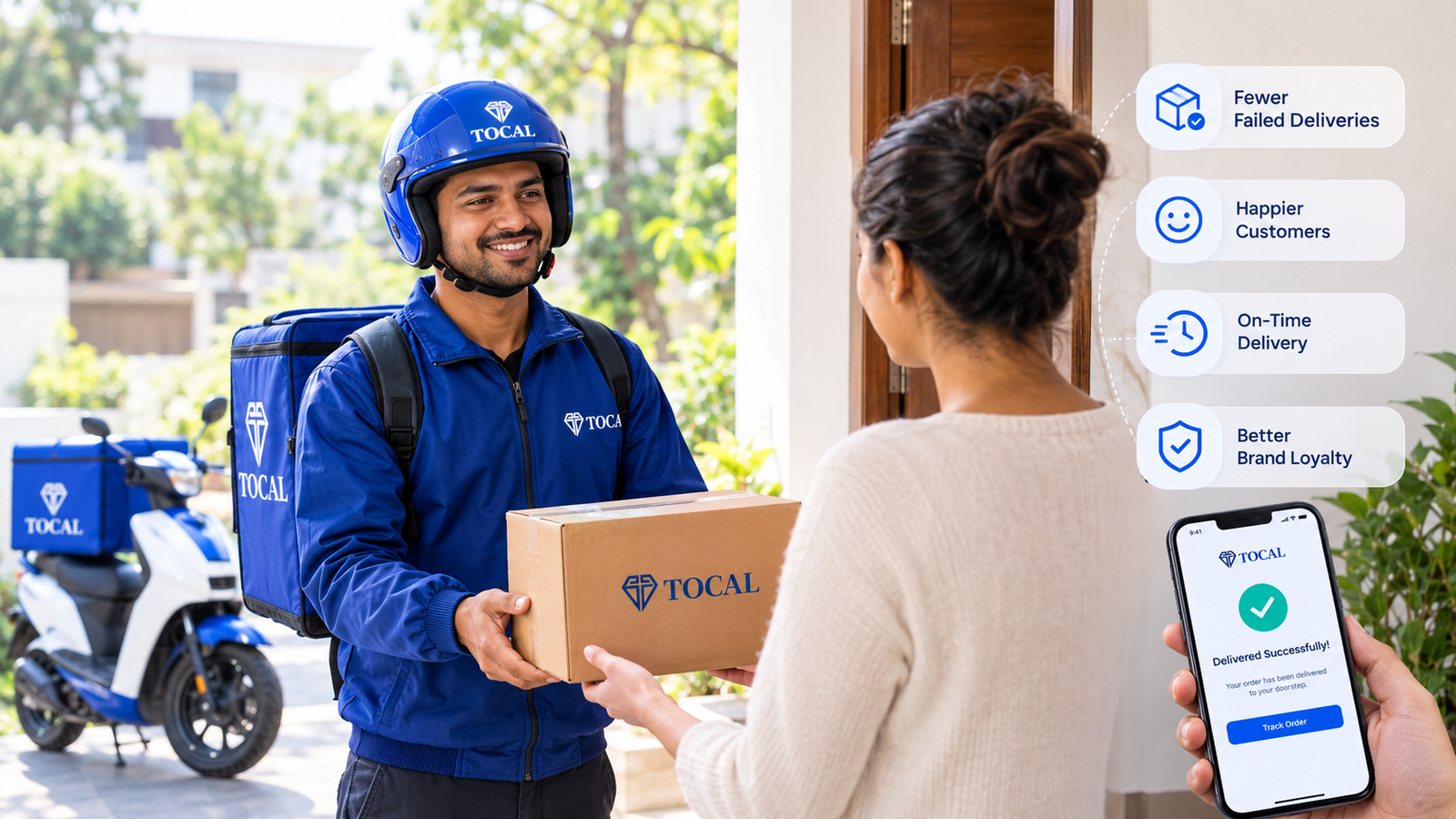
- Lost trust: a customer who waits, chases and finally gets a failed attempt is unlikely to reorder or recommend you
A failed delivery is not a logistics problem alone. It is a customer experience problem that shows up on your balance sheet.
The most common causes
Before fixing anything, know where your own failures come from. The usual suspects are:
- Poor address quality, especially without landmarks or with mistyped pincodes
- Unconfirmed cash on delivery orders, including impulse or fake orders
- Customers not told when to expect the order, so no one is home
- Late or rescheduled deliveries, which make customers lose interest or refuse the parcel
- Inconsistent riders who do not know the area or follow your standards
- Weak packaging, leading to damage in transit
- No visibility, so problems are discovered only when customers complain
Fix 1: Capture clean addresses at checkout
Many failed deliveries are decided before the order is even packed. Improve your checkout so addresses are usable:
- Validate pincodes and flag mismatched city or area entries
- Make a landmark field prominent, especially for apartments and dense areas
- Verify phone numbers, since a working number is the single best defence against a failed attempt
- Offer saved addresses and map pin confirmation for repeat customers
Fix 2: Confirm orders, especially cash on delivery
Cash on delivery lowers friction at checkout, but it also makes refusal easy. A simple confirmation step helps:
- Send an automated message or call to confirm COD orders before dispatch
- Give customers an easy way to correct the address or reschedule
- Encourage prepaid orders with a small incentive
- Flag repeat refusers or suspicious orders before they ship
Fix 3: Let customers choose when to receive the order
An order that arrives when nobody is home fails even if the rider did everything right. Where possible, offer delivery slots or a clear delivery window at checkout, and let customers reschedule easily. Customers who choose the time are far more likely to be there.
Fix 4: Communicate before the rider arrives
Silence is a major cause of failed attempts. A simple communication flow makes a big difference:
- Order confirmed: with the expected delivery window
- Out for delivery: with a live tracking link
- Rider nearby: a short heads-up so the customer is ready
- Delivery attempted or delayed: an immediate update with the next step
This also cuts "where is my order" calls to your support team.
Fix 5: Use trained riders who know their zones
A rider who delivers in the same area every day knows the lanes, the apartment gates and the best times to reach customers. A rider seen for the first time often loses ten minutes finding the address and gives up sooner.
This is the strongest argument for a dedicated delivery fleet: the same trained riders, working fixed zones, handling your brand's orders with your standards. At TOCAL, riders are trained for the brands they serve, and BigBasket saw a 32% reduction in RTOs through consistent performance across zones.
Fix 6: Improve packaging and handling
Damage is a quiet source of refused parcels and unhappy reviews. Check that packaging suits your product type, tamper-evident seals are used where needed, and riders are briefed on fragile or high-value items. A well-packed order also signals care the moment the customer receives it.
Fix 7: Build a smart reattempt process
Not every first attempt will succeed, so what happens next matters:
- Call or message the customer immediately after a missed attempt
- Offer a same-day or next-slot reattempt rather than waiting a day or two
- Record the failure reason every time, so you can see patterns
- Set a clear limit on reattempts before an order is returned
Quick recovery turns many failures into successful deliveries, and shows customers you are paying attention.
Fix 8: Deliver faster from closer to the customer
The longer an order is in transit, the more chances it has to fail. Customers cool off, plans change, and riders face more traffic. Shortening the journey helps on every front:
- Hold stock in fulfilment centers near your busiest customer areas
- Use hyperlocal and same-day delivery for high-demand zones
- Read our guide to micro-fulfilment centres in Bengaluru for how brands deliver faster without a large warehouse
Beyond delivery: the full customer experience
A successful drop is only part of the experience. To turn delivery into loyalty:
- Ask for feedback within a day, and act on delivery complaints quickly
- Make returns and exchanges simple, with clear steps and pickup options
- Keep your promise visible, with honest delivery estimates rather than optimistic ones
- Recover well when things go wrong, with a quick apology, update or credit
KPIs D2C brands should track
You cannot fix what you do not measure. Track these by zone and time slot, not only as city-wide averages:
| KPI | Why it matters |
|---|---|
| First-attempt delivery success | The clearest signal of how well address, communication and riders are working |
| On-time delivery rate | Shows whether your delivery promise is being kept |
| RTO rate | Direct measure of lost revenue and wasted logistics cost |
| Failure reasons | Tells you whether to fix addresses, confirmations or rider performance |
| Complaint rate and delivery rating | The customer's side of the experience |
| Cost per successfully delivered order | The true cost once failed attempts and returns are included |
For a deeper guide to setting targets with your partner, see our article on last-mile delivery SLAs and KPIs.
A 30-day plan to cut failed deliveries
| When | What to do |
|---|---|
| Week 1 | Pull your last 30 to 60 days of failed deliveries and group them by reason, zone and payment mode |
| Week 2 | Fix the quick wins: address validation, COD confirmation and a proactive message flow |
| Week 3 | Pilot a dedicated, trained delivery team in your highest-volume zone with agreed SLAs and live tracking |
| Week 4 | Compare first-attempt success, RTO and complaints against the baseline, then expand what works |
How TOCAL helps D2C brands
TOCAL provides last-mile and hyperlocal delivery in Bengaluru on a dedicated EV fleet, built to help D2C brands scale fulfilment without scaling headcount. Our approach follows three steps:
- Understand: we analyse your order volumes, delivery zones and SLA requirements
- Deploy: we assign the right fleet, trained delivery partners and an operations team
- Manage, track and scale: we monitor performance with live tracking and scale capacity as you grow
With 98%+ on-time delivery across our operations and 35+ brands served, TOCAL combines last-mile delivery, hyperlocal delivery and fulfilment support so your customers get a reliable experience from checkout to doorstep.
Frequently asked questions
What counts as a failed delivery?
A failed delivery is any order that is not handed over successfully on the first attempt. Common causes include customer unavailable, wrong or incomplete address, refused cash on delivery, rider unavailability and delays. Orders that end up returned to the seller are counted as RTO.
Why do D2C brands see high RTO rates?
The biggest drivers are poor address quality, unconfirmed cash on delivery orders, customers who are not informed about delivery timing, late deliveries and inconsistent rider service. Most of these can be reduced with better checkout data, order confirmation and a reliable delivery partner.
How can D2C brands reduce failed deliveries?
Validate addresses at checkout, confirm cash on delivery orders, offer delivery slots, send proactive tracking updates, use trained riders who work fixed zones, improve packaging and run a structured reattempt process.
Does cash on delivery increase failed deliveries?
It can, because unconfirmed cash on delivery orders are easier to refuse or abandon. Confirming orders by call or message and encouraging prepaid orders usually lowers refusals.
Which KPIs should D2C brands track for delivery?
Track first-attempt delivery success, on-time delivery rate, RTO rate, failed delivery reasons, complaint rate, delivery rating and cost per successfully delivered order, by zone and time slot.
Does TOCAL work with D2C brands?
Yes. TOCAL provides last-mile and hyperlocal delivery in Bengaluru on a dedicated EV fleet for D2C brands, with trained riders, live tracking and SLA-backed delivery planned around your volumes and zones.
Final thoughts
Reducing failed deliveries is not one big project. It is a series of small fixes: cleaner addresses, confirmed orders, clear communication, trained riders and faster delivery from closer to the customer. Each one lowers cost and improves the experience, and together they turn delivery into one of your strongest brand moments.
Ready to cut failed deliveries and improve customer experience? Share your order volumes, zones and current delivery challenges, and TOCAL will plan a delivery operation around your D2C brand. Talk to a TOCAL Delivery Expert.