If you cannot measure delivery, you cannot manage it. This guide explains the last-mile delivery SLAs and KPIs that matter in Bangaluru, how to define them clearly, and how operations managers can hold a delivery partner accountable.
Most delivery problems do not start on the road. They start in a contract that never defined what "good" looks like. A partner says deliveries are "mostly on time", the report shows a single city-wide average, and nobody can say whether the service is actually getting better or worse.
A clear last mile delivery SLA in Bangaluru, backed by the right KPIs, fixes this. It turns delivery from a black box into something you can measure, review and improve. This guide is written for operations managers who need to evaluate delivery reliability and partner performance with facts, not impressions.
What is a last-mile delivery SLA?
A service level agreement (SLA) is a written commitment between you and your delivery partner. It defines the level of service you can expect, how it will be measured, and what happens if the target is missed.
A good delivery SLA covers more than "deliver on time". It addresses pickup speed, delivery windows, failed deliveries, tracking, reporting and escalation, so both sides know exactly what is being promised.
SLA vs KPI: what is the difference?
The two terms are often mixed up:
- A KPI is a metric you track to understand performance, such as the percentage of orders delivered on time
- An SLA is a KPI with an agreed target, a clear measurement method and consequences, written into your agreement
In short, KPIs tell you how delivery is performing. SLAs define how it must perform. You need both: KPIs to see the truth, SLAs to hold your partner to it.
Why SLAs matter more in Bangaluru
Bangaluru is one of the hardest cities for last-mile delivery, which is exactly why loose service promises fail here:
- Congestion on corridors like ORR, Whitefield and Electronic City makes delivery times swing widely
- Sudden rain changes rider availability and speed within minutes
- Dense hyperlocal zones such as Koramangala, HSR Layout and Indiranagar behave very differently from outer areas
- High customer expectations for same-day and even 10 to 30 minute delivery leave little room for error
Without defined SLAs, these conditions become excuses. With them, they become variables the partner must plan for.
The KPIs that matter in last-mile delivery
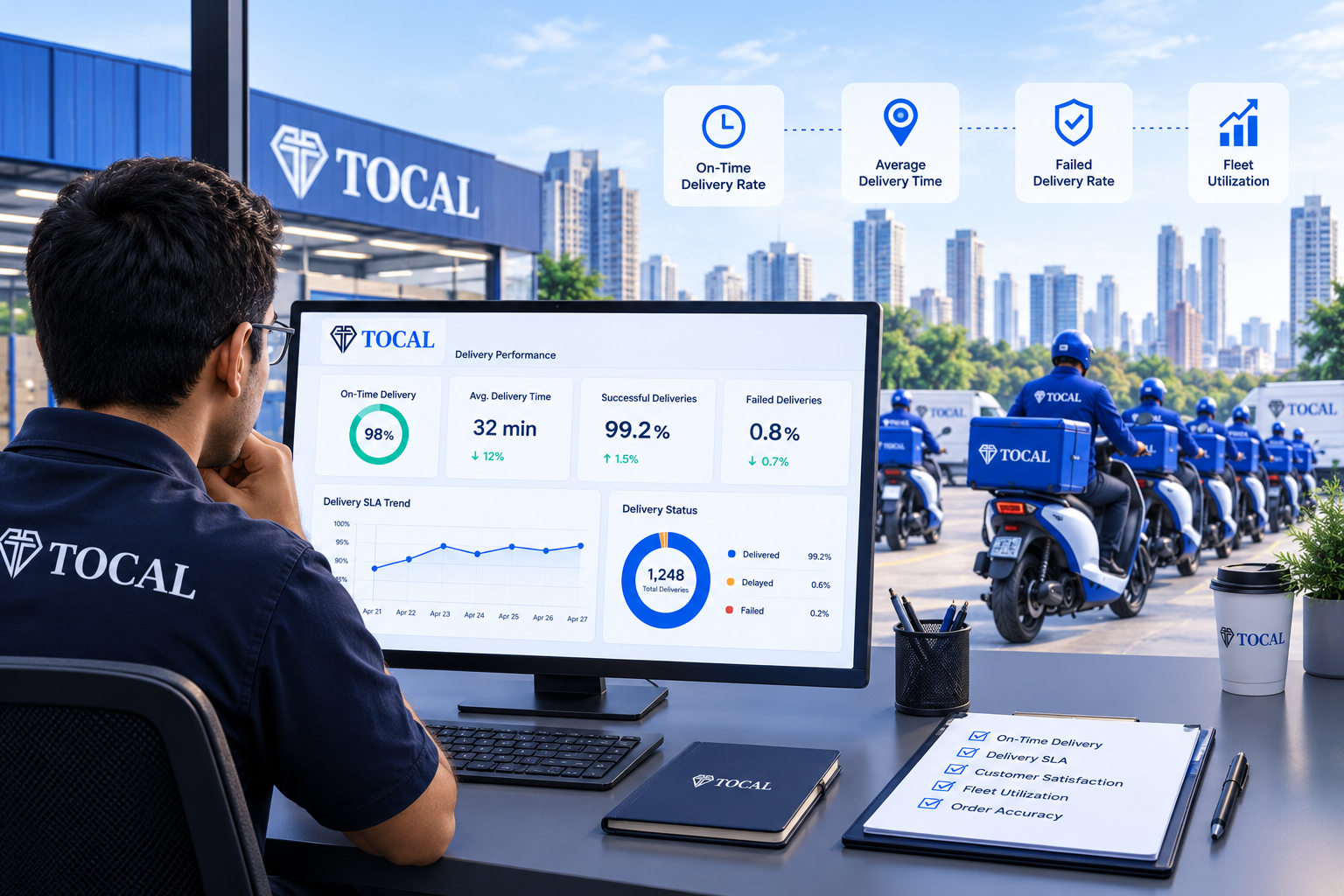
Start with a focused set. Too many metrics hide the ones that matter. These are the KPIs most operations teams rely on:
| KPI | What it tells you | How to calculate it |
|---|---|---|
| On-time delivery rate | Whether promises are being kept | Deliveries within the promised window divided by total deliveries, times 100 |
| First-attempt delivery success | How often the first try works | Orders delivered on first attempt divided by total orders dispatched, times 100 |
| Pickup-to-dispatch time | Speed of rider arrival and departure from your store or hub | Time from order ready to rider departure, tracked as average and slowest cases |
| Delivery time | Real transit performance | Time from dispatch to delivery, by zone and slot |
| Failed delivery and RTO rate | Lost revenue and wasted trips | Failed or returned orders divided by total orders, times 100 |
| Reschedule rate | Reliability of the partner's riders and planning | Orders rescheduled by the partner divided by total orders, times 100 |
| Rider availability | Whether capacity exists when needed | Orders accepted or assigned on time divided by total orders requested |
| Customer complaint and rating | The customer's side of the story | Complaints per 1,000 orders, and average delivery rating |
| Damage and loss rate | Handling quality | Damaged or lost orders divided by total orders, times 100 |
| Cost per delivery | The true cost of the service | Total delivery cost, including failed attempts and reschedules, divided by successful deliveries |
Define "on-time" before you measure it
On-time delivery is the headline KPI, and also the easiest to game. Two partners can report very different numbers for the same service because they define it differently. Agree these points in writing:
- The promise: is on-time measured against the window shown to your customer, or against an internal estimate?
- The clock: when does it start (order placed, order ready, rider dispatched) and when does it stop (arrival, handover, confirmation)?
- Order types: same-day, scheduled, hyperlocal and bulky orders should each have their own target
- Exclusions: which delays are genuinely outside the partner's control, such as wrong addresses or customer unavailability, and who verifies them?
A target is only as strong as the definition behind it. Agree the definition first, then the number.
Averages hide problems: look deeper
A city-wide average can look healthy while specific zones or time slots are failing. To see the real picture:
- Break results down by zone, so a weak area does not hide behind a strong one
- Look at time slots, because evening peaks and rainy hours behave differently from mid-morning
- Check the slowest deliveries, not only the average, since customers remember the late ones
- Compare by order type, such as hyperlocal versus scheduled
- Track trends over weeks, not just single days
What a strong last-mile delivery SLA includes
Use this as a checklist when drafting or reviewing an agreement:
- Clear metrics and definitions: on-time, first attempt, failed delivery and others, defined in plain language
- Targets by service type: hyperlocal, same-day and scheduled delivery treated separately
- Measurement method: who measures, from which data source, and how disputes are settled
- Coverage: zones and pincodes covered, and service hours
- Reporting: what reports you receive, how often and in what format
- Consequences: service credits, corrective action plans or review triggers when targets are missed
- Escalation matrix: a named point of contact and response times for issues
- Peak-period terms: how capacity and targets are handled during festive and campaign spikes
- Review clause: a regular date to revisit targets as volumes and zones change
Red flags in delivery SLAs
Watch for these warning signs when evaluating a partner:
- Vague language like "best effort" or "as far as possible" in place of measurable targets
- No consequences for missed targets, which makes the SLA a brochure rather than a commitment
- Only city-wide averages with no zone or slot breakdown
- Self-reported numbers only, with no live tracking or data you can verify
- Long lists of exclusions that make almost any delay "not the partner's fault"
- No named contact or escalation path when things go wrong
Reporting and review rhythm
An SLA only works if someone reads the numbers. A simple rhythm keeps it alive:
- Daily: check live exceptions, delayed orders and failed deliveries
- Weekly: review KPIs by zone and slot, and agree fixes for the week ahead
- Monthly: hold a formal performance review against SLA targets, including cost per delivery
- Quarterly and before peak seasons: revisit targets, capacity and zones
Why a dedicated fleet makes SLAs easier to keep
An SLA is only as good as the capacity and control behind it. With shared rider pools, the partner often cannot guarantee riders at all, so accountability stays limited. With a dedicated delivery fleet, riders are reserved and trained for your business, performance is monitored against defined SLAs, and one team answers for the result. That makes it realistic to agree meaningful targets and to hold the partner to them. For spikes, see how to plan peak season delivery so your SLAs survive busy periods.
How TOCAL approaches delivery SLAs
TOCAL provides SLA-backed delivery in Bengaluru on a dedicated EV fleet, with real-time tracking and a single point of contact. Our approach follows three steps:
- Understand: we analyse your order volumes, delivery zones and SLA requirements
- Deploy: we assign the right fleet, trained delivery partners and an operations team
- Manage, track and scale: we monitor performance against agreed SLAs and scale capacity as you grow
Results from clients show what this looks like in practice: Apollo Pharmacy reports 98%+ on-time delivery, BigBasket saw a 32% reduction in RTOs, and Blinkit rates TOCAL riders 4.8/5. Explore our last-mile delivery and hyperlocal delivery services, or see how we support enterprises and quick commerce, D2C brands and retail and FMCG.
Questions to ask a delivery partner about SLAs
- How do you define and measure on-time delivery?
- Can I see results by zone and time slot, not just an average?
- What happens when a target is missed, and is it written into the agreement?
- Do I get live tracking and data I can verify independently?
- Who is my named contact, and how fast do you respond to escalations?
- How do targets change during peak periods?
- How often will we review performance together?
Frequently asked questions
What is a last-mile delivery SLA?
A last-mile delivery SLA is a written agreement between a business and its delivery partner that defines the service level expected, such as on-time delivery rate, pickup time, failed delivery limits and reporting, along with what happens when targets are missed.
What is the difference between an SLA and a KPI in delivery?
A KPI is a metric you track to understand performance. An SLA is a KPI with an agreed target, a measurement method and consequences, written into your contract with the delivery partner.
Which KPIs matter most for last-mile delivery in Bangaluru?
The core KPIs are on-time delivery rate, first-attempt delivery success, pickup-to-dispatch time, failed delivery and RTO rate, reschedule rate, customer complaint rate, damage or loss rate, and cost per delivery. Track them by zone and time slot, not only as city-wide averages.
How should on-time delivery be measured?
Measure it against the delivery promise shown to the customer, with clearly defined start and stop times. Divide deliveries completed within the promised window by total deliveries, and report it by zone, time slot and order type.
How often should I review delivery partner performance?
Check live exceptions daily, review KPIs weekly, hold a formal performance review monthly and revisit SLA targets quarterly or ahead of peak seasons.
Does TOCAL offer SLA-backed delivery?
Yes. TOCAL runs SLA-backed delivery in Bengaluru on a dedicated EV fleet, with real-time tracking and a single point of contact, planned around each client's volumes, zones and SLA requirements.
Final thoughts
Reliable delivery is not an accident. It comes from clear definitions, a focused set of KPIs, agreed targets with real consequences, and a regular habit of reviewing the numbers. Operations managers who put this in place stop arguing about whether delivery is "good enough" and start improving it with data.
Want delivery you can measure and hold to account? Share your volumes, zones and SLA requirements, and TOCAL will plan an SLA-backed delivery operation around your business. Talk to a TOCAL Delivery Expert.