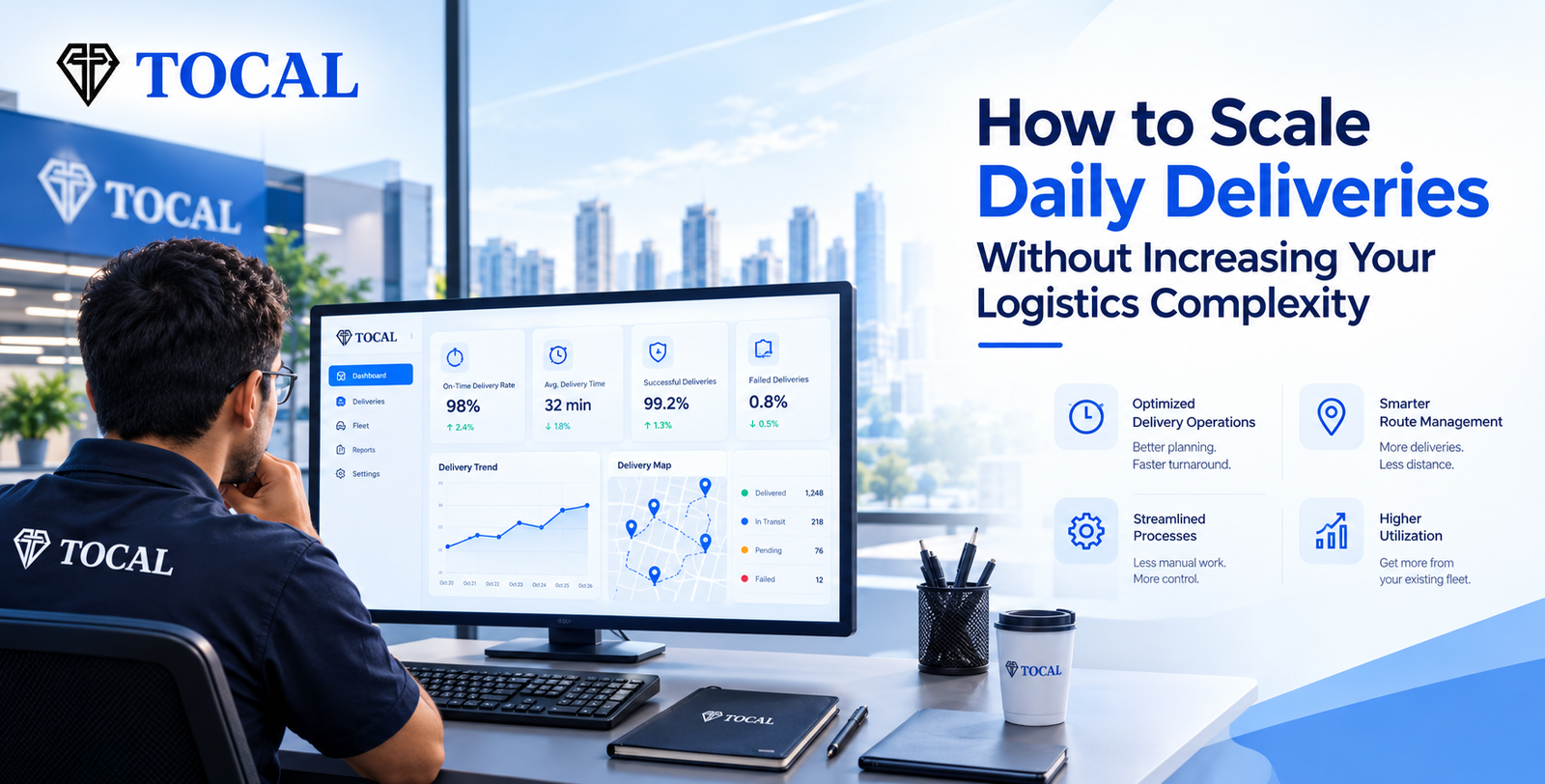
Growing from a few hundred to a few thousand deliveries a day should not mean more vendors, more spreadsheets and more firefighting. Here is how to scale daily deliveries in Bengaluru by simplifying first: standardise, consolidate, zone your city and let live data do the heavy lifting.
Most growing brands hit the same wall. Orders climb, so a second delivery vendor is added. Then a third for a new area. Someone builds a spreadsheet to track who delivered what. Customer support starts chasing riders on WhatsApp. Volumes are higher, but so is the chaos, and every extra order now costs more effort than the last.
It does not have to work this way. The businesses that scale daily deliveries in Bengaluru smoothly are rarely the ones with the most complicated setup. They are the ones who kept the operation simple while volumes grew. This guide shows how.
Why scaling deliveries usually adds complexity
Complexity is not caused by volume itself. It comes from how businesses react to volume:
- Too many vendors, each with its own app, rates, reports and escalation contacts
- Manual steps, such as assigning orders by hand or sending tracking updates one by one
- Exceptions becoming the rule, with special handling for certain areas, products or customers
- No single view, so nobody can say how many orders are late right now
- Inconsistent riders, which means every delivery quality problem needs its own fix
Each of these feels small on its own. Together, they mean that doubling your orders more than doubles your operational effort.
Warning signs your logistics is getting too complex
If several of these sound familiar, complexity is already costing you:
- You manage three or more delivery vendors for one city
- Your team spends hours each day assigning, chasing or reconciling deliveries
- "Where is my order" calls and messages keep rising faster than orders
- On-time delivery varies sharply by area, day or rider
- You cannot say your cost per order without opening a spreadsheet
- A busy day turns into a crisis instead of a routine
The core idea: scale volume, not moving parts
The goal is simple. When orders double, the number of vendors, processes and daily decisions should stay roughly the same. Everything below follows that single rule.
If growth needs a new vendor, a new spreadsheet or a new person for every extra thousand orders, the system is not scaling. It is just getting heavier.
Step 1: Standardise one delivery process before you scale it
Scaling a messy process only gives you more mess. Before adding volume, write down one standard flow that every order follows:
- Order to pickup: how orders are packed, labelled and handed over, and how long that should take
- Pickup to delivery: the standard route logic, delivery attempts and proof of delivery
- Exceptions: what happens when a customer is unavailable, an address is wrong or an order is refused
- Closure: how deliveries, failures and returns are recorded and reported
Fewer exceptions mean fewer decisions. A short, clear playbook is worth more than a clever workaround.
Step 2: Consolidate to one primary delivery partner
Spreading volume across many vendors may look like a safety net, but it multiplies coordination. Each vendor needs onboarding, performance reviews, invoices and escalations.
A dedicated delivery fleet from a single primary partner gives you consistent riders, one SLA to hold and one team to call. Keep a second option only as overflow for unplanned surges. If you are weighing the models, read our comparison of dedicated fleet vs delivery apps.
Step 3: Divide the city into fixed delivery zones
Zone-based delivery is one of the simplest ways to keep a growing operation under control. Instead of any rider going anywhere, split the city into clear zones and assign riders to them.
- Riders learn their area, including lanes, gated communities and landmarks, so deliveries get faster and failed attempts drop
- Orders cluster naturally, so each trip covers more drops over shorter distances
- Performance is easy to read, because you can compare zones instead of untangling individual routes
- Scaling becomes repeatable, since a busy zone just gets more riders rather than a new process
In a city like Bengaluru, where areas such as Koramangala, HSR Layout, Indiranagar and Whitefield each behave differently, zoning pays off quickly.
Step 4: Position stock closer to where orders come from
Long trips from one central warehouse create delays, higher costs and more rider hours for every extra order. Shortening the distance removes complexity at the source.
- Hold fast-moving SKUs in fulfilment centers near your highest-demand zones
- Use smaller hubs so same-day delivery becomes routine rather than a stretch (see our guide to micro-fulfilment centres in Bengaluru)
- Stage packed orders by zone, so riders collect and go instead of waiting
Step 5: Automate dispatch, tracking and customer updates
Anything your team does by hand for every order will break as volumes grow. Automate the repeatable parts and keep people for the exceptions:
- Automatic order assignment by zone and rider availability
- Live tracking of riders and orders, visible to your team in one dashboard
- Automated customer messages with tracking links and status updates, which cut support calls
- Digital proof of delivery, so reconciliation does not depend on phone calls and screenshots
Step 6: Add a flexible capacity layer instead of a bigger fleet
You do not need a fleet sized for your busiest day. Think in layers:
- Base fleet: dedicated riders for your steady daily volume
- Flex layer: extra vehicles and riders added for growth phases, campaigns or seasonal peaks. EV fleet rentals suit this well, as you add capacity when needed and scale back without owning vehicles or handling maintenance and charging
- Overflow: shared delivery apps for rare, unplanned spikes
This keeps service steady while cost follows demand. For spike planning in particular, see our guide on peak season delivery planning in Bengaluru.
Step 7: Track a few metrics that actually matter
More volume often brings more dashboards. Resist that. Five numbers are enough to run a scaling operation:
- On-time delivery %, overall and by zone
- Cost per order, including failed attempts and returns
- Failed or returned delivery rate
- Average delivery time by zone
- Complaints per 1,000 orders
Review them weekly with your delivery partner. If a number slips, you will know exactly which zone to look at.
Complexity trap vs simple scaling
Here is how the two approaches compare as daily volumes grow:
| Area | Complexity trap | Simple scaling |
|---|---|---|
| Delivery partners | A new vendor for every area or spike | One primary partner, one overflow option |
| Rider assignment | Manual, order by order | Fixed zones with automatic assignment |
| Visibility | Separate apps, reports and chats | One live dashboard |
| Customer updates | Support team answers each query | Automated tracking links and status messages |
| Capacity | Fixed fleet sized for the peak, or scramble when it hits | Base fleet plus flexible EV capacity |
| Cost control | Hard to see, calculated after the month ends | Clear cost per order, reviewed weekly |
A simple 30-60-90 day plan
- Days 1 to 30: document your standard delivery process, map orders by zone, and list every vendor and manual step you use today
- Days 31 to 60: consolidate to a primary partner, set zones and SLAs, switch on live tracking and automated customer updates
- Days 61 to 90: add flexible capacity where demand is growing, review your five metrics weekly and retire the workarounds you no longer need
How TOCAL helps brands scale without the complexity
TOCAL builds dedicated delivery infrastructure in Bengaluru around an EV-only fleet, so your growth does not mean managing more vendors. Our approach follows three steps:
- Understand: we analyse your order volumes, delivery zones and SLA requirements
- Deploy: we put the right fleet, trained delivery partners and operations team in place
- Manage, track and scale: we monitor performance live and scale capacity up or down as your volumes change
With 98%+ on-time delivery, 30 lakh+ green deliveries completed and 35+ brands served, TOCAL supports D2C brands, retail and FMCG, SMEs and individual sellers and enterprises and quick commerce, through hyperlocal delivery, last-mile delivery, fulfilment centers and EV fleet rentals.
Frequently asked questions
How do I scale daily deliveries without hiring a large logistics team?
Standardise your process, work with one dedicated delivery partner instead of many, use fixed delivery zones and rely on live tracking and automated updates. This keeps your internal team small while volumes grow.
Why does logistics get more complex as order volumes grow?
Complexity usually grows because businesses add more vendors, more manual steps and more exceptions to cope with extra volume. Each addition needs coordination, reporting and issue handling, which multiplies the effort.
Is it better to use one delivery partner or several?
For steady daily volumes, one primary partner with a dedicated fleet is simpler to manage, track and hold to an SLA. Many businesses keep a second option only as overflow for unplanned spikes.
What metrics should I track when scaling deliveries?
Keep it to a few: on-time delivery percentage, cost per order, failed or returned delivery rate, average delivery time by zone and customer complaints per thousand orders.
Can I scale delivery capacity up and down as demand changes?
Yes. A base fleet covers steady volumes, and short-term fleet rentals or planned capacity increases add riders and vehicles when demand rises, then scale back afterwards.
Does TOCAL help growing brands scale daily deliveries?
Yes. TOCAL serves D2C brands, retail and FMCG, SMEs and individual sellers, and enterprises in Bengaluru, with capacity planned around your volumes, zones and SLA needs.
Final thoughts
Scaling deliveries is not about adding more of everything. It is about building a simple system that handles more orders without needing more attention. Standardise your process, consolidate your partners, divide the city into zones, automate the repeatable work and add flexible capacity only where demand calls for it.
Ready to grow your daily deliveries without the headache? Share your current volumes, service areas and SLA needs, and TOCAL will plan a delivery setup that scales with you. Talk to a TOCAL Delivery Expert.