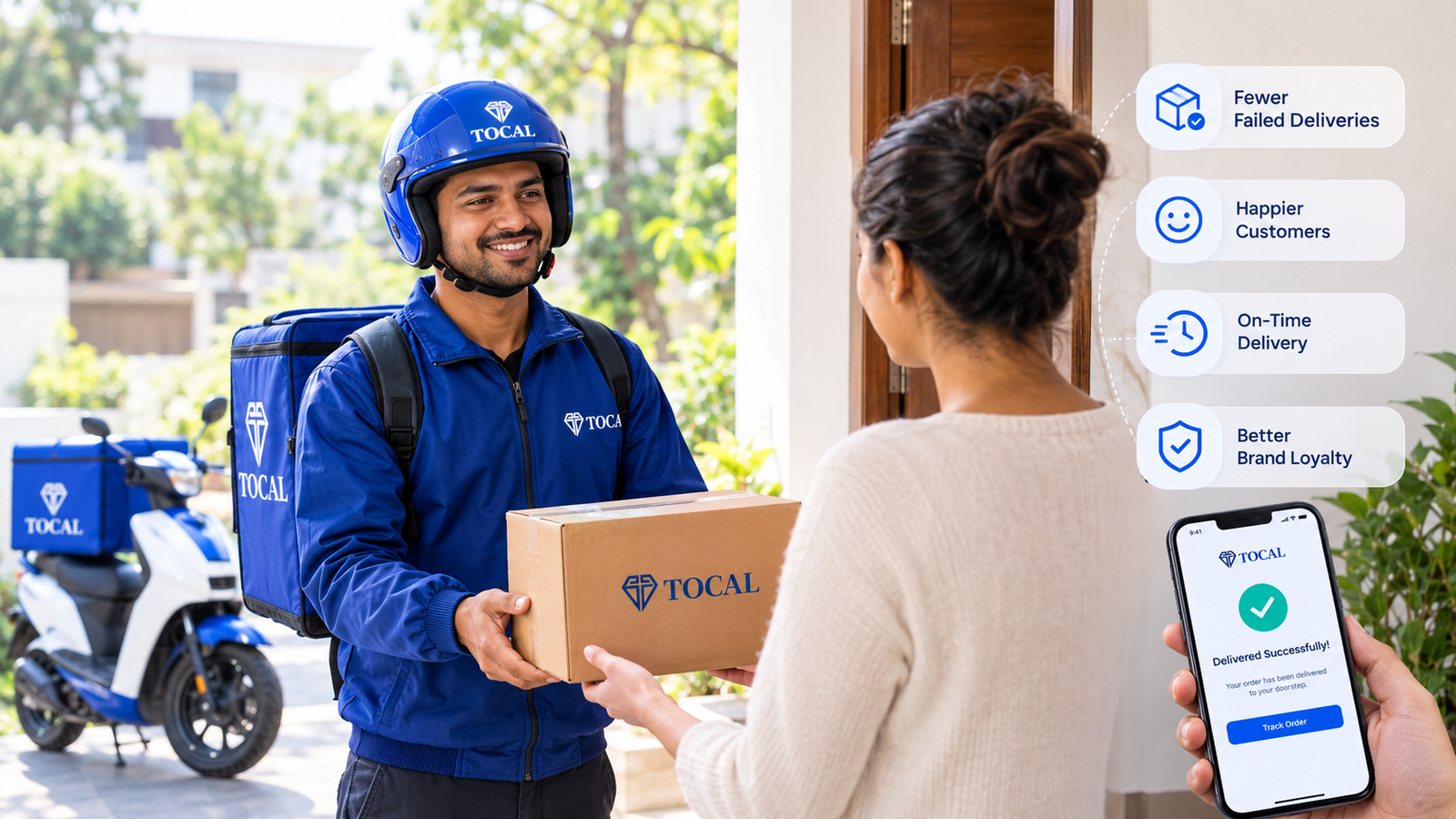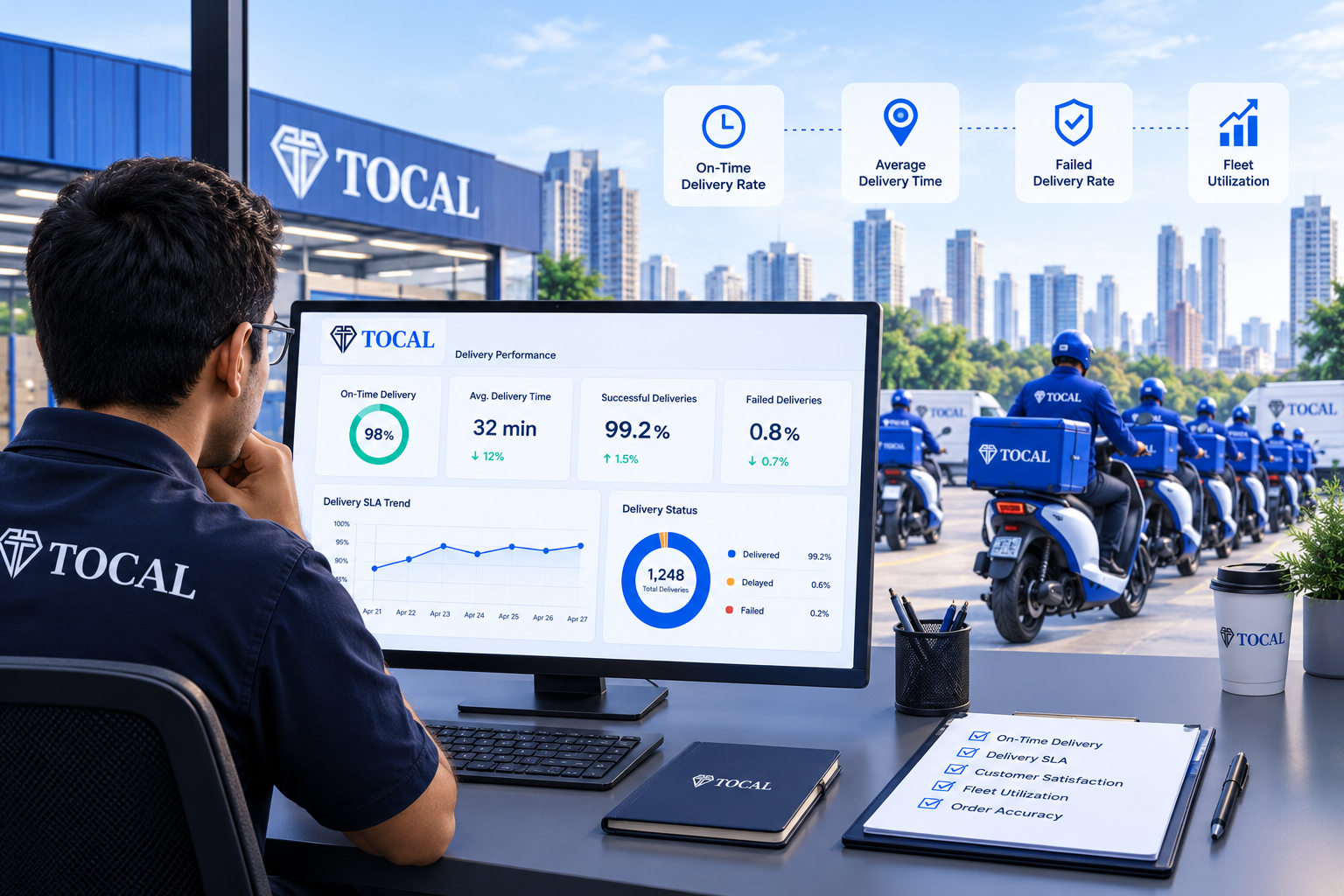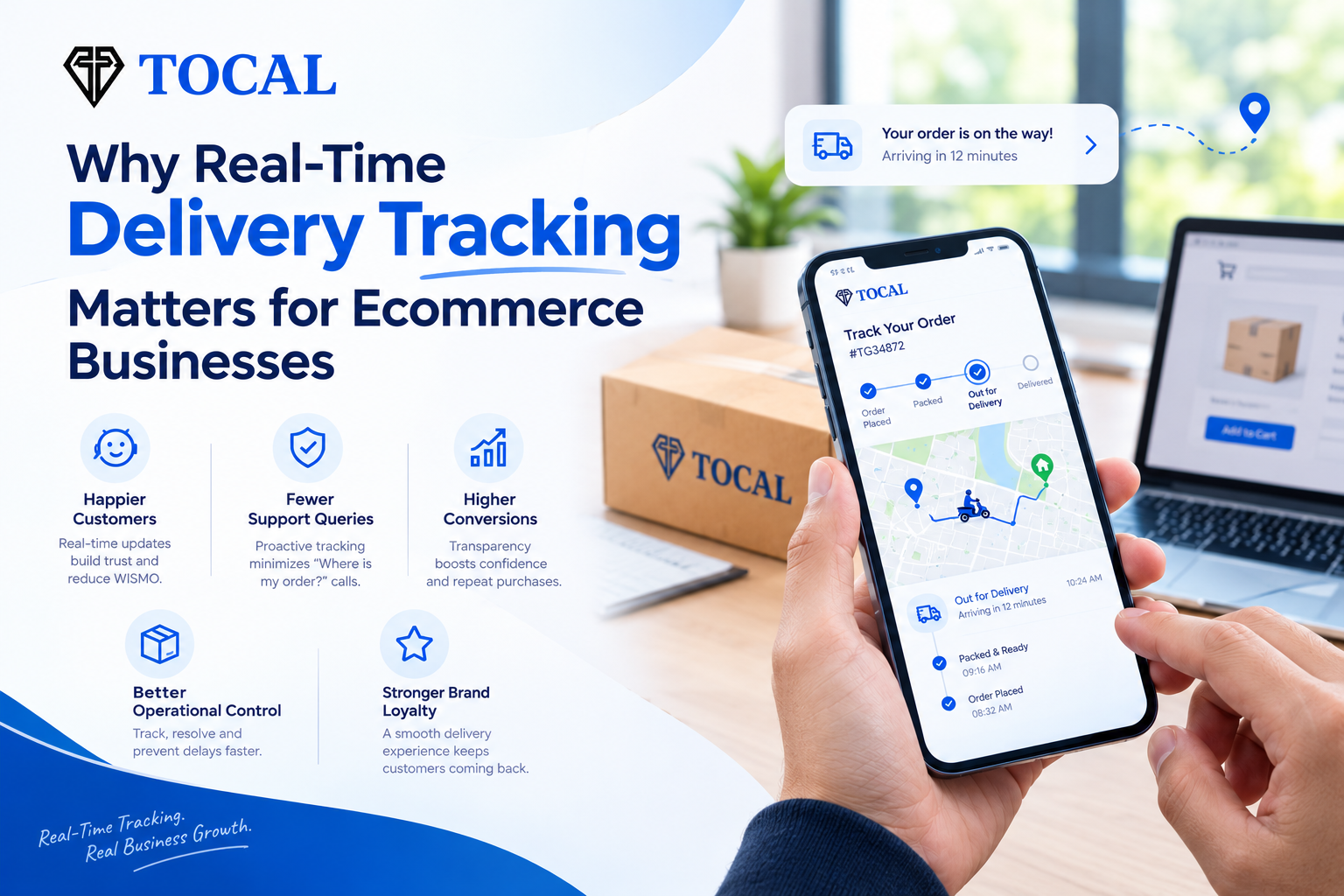
Real-time delivery tracking lets you and your customers see every order from pickup to doorstep. It cuts "where is my order" calls, catches delays before customers do and gives you proof to hold delivery partners to their SLAs. Here is why it matters for ecommerce, and how to get it right in Bengaluru.
Quick answer
Why does real-time delivery tracking matter for ecommerce businesses? Because the delivery is where customers judge your brand, and tracking makes it visible and manageable. It reduces "where is my order" contacts, lets your team fix delays early, lowers failed deliveries, builds customer trust, speeds up dispute and cash reconciliation, and gives you data to improve zones, riders and SLAs.
Key takeaways
- Tracking shifts delivery from reactive (answering complaints) to proactive (fixing problems first).
- Customers care less about speed alone and more about knowing when to expect their order.
- The core features are live location, status updates, a customer tracking link, delay alerts and proof of delivery.
- Tracking works best with a dedicated fleet, fixed zones and a clear SLA behind it.
- In Bengaluru, rain and traffic make live ETAs and proactive updates especially valuable.
Ask any ecommerce support team what fills their inbox, and "where is my order?" sits near the top. Each of those messages is a customer who was not told what is happening, and a support agent who had to chase a rider for an answer the system should have given in seconds.
Real-time delivery tracking solves this at the root. This guide covers what it is, how it works, the business benefits, features worth insisting on, and how to roll it out without adding complexity.
What is real-time delivery tracking?
Real-time delivery tracking is the ability to see an order's location and status as it moves from the pickup point to the customer's doorstep. For ecommerce, it normally includes three things working together:
- Live rider location and order status captured from the rider's app
- A customer tracking link with status updates and an estimated arrival window
- A business dashboard showing every active order, delays and exceptions in one place
How does real-time delivery tracking work?
Behind a simple tracking link is a short chain of events:
| Stage | What happens | Who sees it |
|---|---|---|
| Order assigned | The order is linked to a rider and zone | Your team |
| Picked up | The rider confirms pickup from your store or warehouse | Your team and customer |
| Out for delivery | Live location is shared and the ETA is calculated | Your team and customer |
| Delay or exception | An alert is raised if the order is late or at risk | Your team and delivery partner |
| Delivered or failed | Proof of delivery or a recorded failure reason is captured | Your team and customer |
8 reasons real-time delivery tracking matters for ecommerce businesses
1. Fewer "where is my order" calls and messages
When customers can open a link and see their order's status and estimated arrival, most of them stop asking. Your support team spends less time chasing riders and more time on issues that actually need a human.
2. Customers trust brands that keep them informed
People tolerate a slightly longer delivery window far more easily than silence. Clear status updates make the wait feel shorter and the brand feel reliable, which supports reviews and repeat purchases.
3. Delays are caught before customers notice
With a live dashboard and alerts, your team sees an order stuck at pickup or a rider running late and can reroute, reassign or message the customer first. That turns a likely complaint into a managed exception.
4. Fewer failed deliveries
When the customer is told the rider is nearby, they are more likely to be available. Tracking also records failure reasons, such as unreachable customer or wrong address, so you can fix patterns instead of guessing.
5. Accountability against your SLA
Timestamps for pickup, dispatch and delivery turn SLA reviews into facts rather than arguments. You can see exactly which zones or time slots slip and take it up with your delivery partner using data.
6. Faster dispute and cash reconciliation
Proof of delivery settles "I never received it" claims quickly. For cash-on-delivery orders, a clear delivery record makes reconciliation simpler and reduces losses from mismatched entries.
7. Better decisions from delivery data
Tracking data shows average delivery time by zone, peak-hour slowdowns, rider performance and failure hotspots. That informs where to add riders, where to place stock and what delivery windows to show at checkout.
8. Smoother operations during peak days
Sales and festive days are when problems snowball. Real-time visibility lets you shift capacity to the zones where delays build up. See our guide to peak season delivery planning in Bengaluru for how this fits into a wider plan.
The best delivery experience is not the fastest one. It is the one where the customer always knows what is happening.
What features should a delivery tracking system have?
Not every tracking tool is equal. Use this checklist when you evaluate a delivery partner or software:
| Feature | What it does | Why it matters |
|---|---|---|
| Live rider location | Shows the rider's position on a map | Lets your team and customers see real progress |
| Status updates | Marks each stage from pickup to delivery | Removes guesswork and support queries |
| Customer tracking link | Gives shoppers self-service visibility | Cuts "where is my order" contacts |
| Dynamic ETA | Refreshes arrival time as the trip progresses | Keeps promises realistic in traffic and rain |
| Delay alerts | Flags late or at-risk orders | Lets you act before customers complain |
| Proof of delivery | Records completed or failed deliveries | Speeds up disputes and reconciliation |
| Zone-level reporting | Breaks performance down by area and time slot | Shows where to add capacity or fix routes |
Why tracking matters even more in Bengaluru
Bengaluru is a hard city for delivery promises. Congestion on corridors such as ORR and around Whitefield, sudden rain, and dense neighbourhoods like Koramangala, HSR Layout and Indiranagar can all change an arrival time within minutes.
In this environment, a fixed ETA set at checkout is often wrong. Live tracking with refreshed estimates, combined with realistic delivery windows and proactive delay messages, keeps customers informed even when conditions change. It works best with riders who know their zones, which is why many brands pair tracking with dedicated delivery riders and hyperlocal delivery.
How to implement real-time delivery tracking in 5 steps
- Decide what you want to see: list the statuses, delay triggers and reports your team and customers need
- Choose a partner with tracking built in: a partner that provides live tracking as part of delivery saves you from building your own system
- Connect orders and customer updates: make sure order data flows to the partner and tracking links reach customers by message or email
- Set alert rules and escalation: define what counts as late, who gets alerted and who acts
- Review weekly: use tracking data to review on-time %, failure reasons and zone performance with your partner
Which metrics should you track?
- "Where is my order" contacts per 1,000 orders: the clearest sign that tracking is working
- On-time delivery %, overall and by zone
- ETA accuracy: how often orders arrive within the promised window
- Failed delivery rate and top failure reasons
- Average delivery time by zone and time slot
Keep it to these few. For a wider view on staying simple as you grow, read how to scale daily deliveries without increasing logistics complexity.
Common tracking mistakes to avoid
- Tracking only for your team, without giving customers a link
- Showing one exact ETA, instead of a realistic window that adjusts
- No alert rules, so the dashboard is only checked after complaints arrive
- Using data only to blame, instead of fixing zones, slots and processes
- Several tracking tools across several vendors, which brings back the complexity tracking should remove
How TOCAL helps ecommerce brands with tracked deliveries
TOCAL builds dedicated delivery infrastructure in Bengaluru around an EV-only fleet, with deliveries monitored live and tracked end-to-end. Our approach follows three steps:
- Understand: we analyse your order volumes, delivery zones and SLA requirements
- Deploy: we put the right fleet, trained delivery partners and operations team in place
- Manage, track and scale: we monitor performance live and scale capacity up or down as your volumes change
With 98%+ on-time delivery, 30 lakh+ green deliveries completed and 35+ brands served, TOCAL supports D2C brands, retail and FMCG, SMEs and individual sellers and enterprises and quick commerce, through hyperlocal delivery, last-mile delivery, fulfilment centers and EV fleet rentals.
Frequently asked questions
What is real-time delivery tracking?
Real-time delivery tracking is the ability to see where an order is and what its status is while it moves from pickup to the customer's doorstep. It usually combines rider GPS location, order status updates, a customer tracking link and a dashboard for the business.
Why is real-time delivery tracking important for ecommerce?
It reduces "where is my order" queries, lets your team spot delays before customers do, lowers failed deliveries, builds trust with customers, and gives you data to hold delivery partners to their SLAs.
How does real-time delivery tracking work?
The rider's app shares live location and status events such as picked up, out for delivery and delivered. These feed a tracking link for the customer and a dashboard for the business, with alerts when an order is delayed or at risk.
Does delivery tracking reduce customer support calls?
Yes. When customers can see their order status and estimated arrival themselves, far fewer of them need to call or message to ask where it is. Proactive updates on delays reduce contacts further.
What features should I look for in a delivery tracking system?
Look for live rider location, status updates at each stage, a shareable customer tracking link, accurate estimated arrival times, delay alerts, proof of delivery, zone-level reporting and easy export of data for SLA reviews.
Can small ecommerce businesses afford real-time tracking?
Yes. Tracking is usually part of the delivery partner's service rather than a separate system you build. Small businesses can get live tracking by choosing a partner that includes it, without investing in their own technology.
How accurate is estimated delivery time in Bengaluru?
Accuracy depends on rider assignment, zone knowledge and conditions. Bengaluru traffic and sudden rain can shift arrival times, so good systems refresh estimates as the trip progresses and show realistic delivery windows rather than a single exact time.
Does TOCAL offer real-time delivery tracking?
Yes. TOCAL delivers in Bengaluru with an EV-only fleet and monitors performance live, with tracked end-to-end delivery for D2C brands, retail and FMCG, SMEs and individual sellers, and enterprises.
Final thoughts
Real-time delivery tracking is no longer a nice-to-have for ecommerce. It protects customer trust, cuts support load, exposes delays early and gives you facts to improve your operation. Choose a partner with tracking built in, set clear alerts and SLAs, and review the data every week.
Want live, end-to-end tracked deliveries for your ecommerce business in Bengaluru? Share your expected volumes, service areas and SLA needs, and TOCAL will plan a tracked delivery setup around your business. Talk to a TOCAL Delivery Expert.