Both hyperlocal delivery and courier services get a parcel from A to B, but they work in very different ways. One moves orders within a city in hours, the other moves parcels across cities through a network of hubs. This guide explains the difference, compares them side by side and helps you decide which one your business needs.
Quick answer
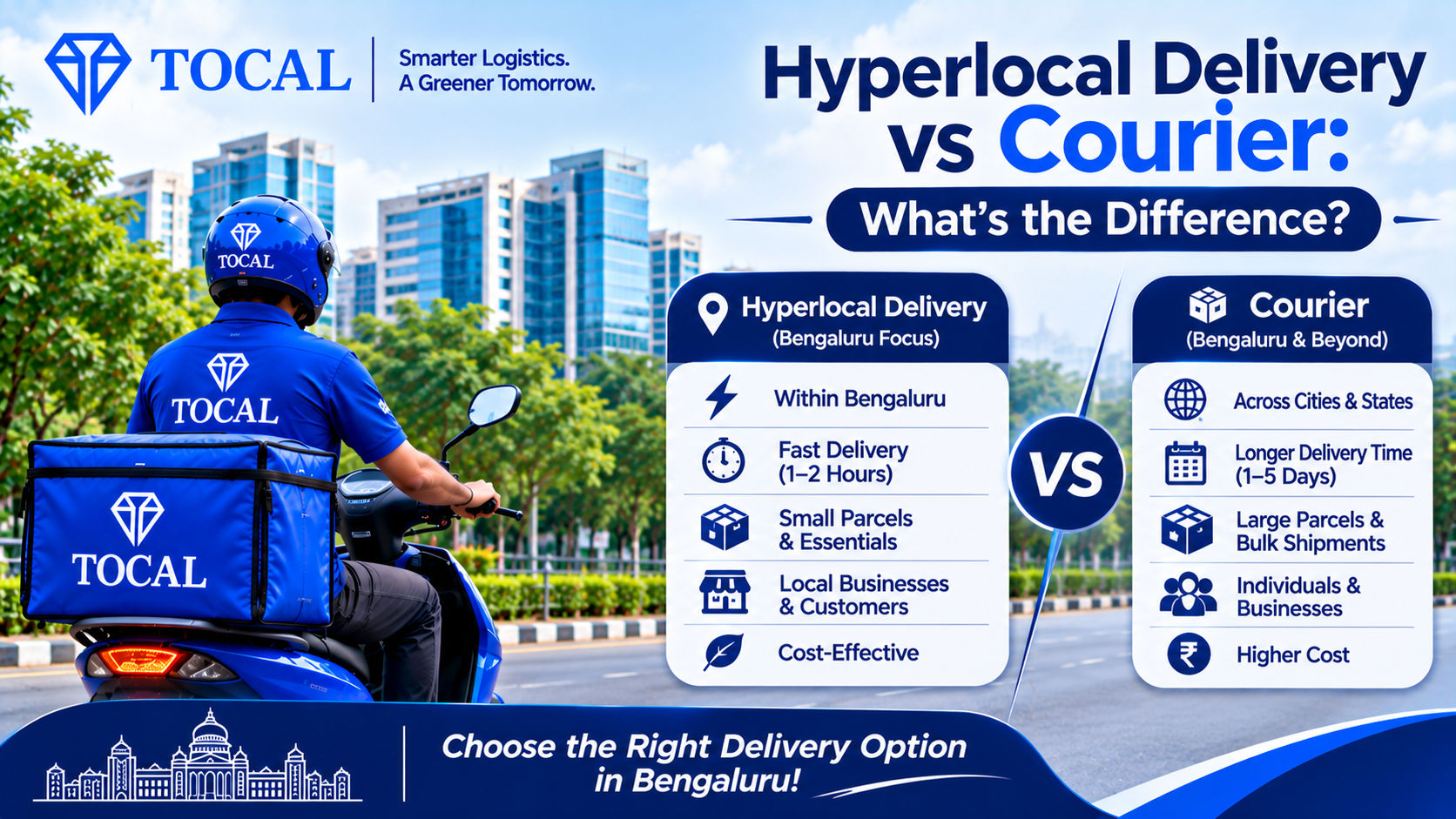
What is the difference between hyperlocal delivery and courier? Hyperlocal delivery moves orders within a city or small area, usually directly from a pickup point to the customer by a rider, often within hours. A courier moves parcels through a network of hubs and linehaul transport, usually between cities, and typically takes days. Use hyperlocal for fast, in-city delivery and a courier for deliveries to other cities. Many sellers use both.
Key takeaways
- Hyperlocal is direct and local; a courier is hub-based and wide-ranging.
- Hyperlocal suits same-day and short-window delivery inside a city; couriers suit other cities and states.
- Pricing works differently: couriers usually price by weight and zone, hyperlocal by distance, slot or order.
- Compare options by cost per successfully delivered order, not the headline rate.
- A hybrid, routing orders by pin code, often works best.
You have started selling online and need to get orders to customers. You hear two terms: "courier" and "hyperlocal delivery". They sound similar, but choosing the wrong one can mean slow deliveries, high costs or unhappy customers.
This guide explains hyperlocal delivery vs courier in plain language: how each works, where each is strong and how to choose.
What is hyperlocal delivery?
Hyperlocal delivery is delivery within a small area, such as a neighbourhood or a city, usually from a nearby store, hub or fulfilment point. A rider collects the order and takes it straight to the customer, often on the same day and sometimes within hours.
- Direct trips: few handoffs, no long-distance transport
- Short distances: usually within one city
- Fast windows: same-day or time-slot delivery
- Live tracking: riders can often be followed on a map
Learn how it works in TOCAL hyperlocal delivery.
What is courier delivery?
Courier delivery moves parcels through a network of pickup points, sorting hubs and transport links, often between cities and states. A parcel is collected, sorted, carried over longer distances and then delivered by a local rider or driver in the destination area.
- Hub and spoke: parcels pass through one or more sorting hubs
- Wide coverage: many cities, towns and pin codes
- Standard timelines: usually days, with faster options on some routes
- Tracking by consignment number: status updates as the parcel moves between hubs
Hyperlocal delivery vs courier: side-by-side comparison
| Factor | Hyperlocal delivery | Courier |
|---|---|---|
| Coverage | Within a city or defined local zones | Across cities, states and often the country |
| Typical speed | Hours; same-day or slot-based | Days, with faster options on some routes |
| How it moves | Pickup point to customer, directly | Pickup, hub sorting, linehaul, destination hub, delivery |
| Number of handoffs | Few | Several |
| Pickup | Usually quick, from your store or hub, often at scheduled times | Usually scheduled pickups, sometimes at set daily windows |
| Tracking | Live location and status in many cases | Status by hub scan and milestone |
| Pricing basis | Usually distance, slot or order based | Usually weight slab and zone, with extra fees such as COD |
| Best parcel types | Small to medium parcels, gifts, perishables, urgent items | Wide range, including heavier and multi-parcel shipments |
| Handling | Fewer touches, so lower handling risk on short trips | More touches through hubs, so stronger packing matters |
| Cash on delivery | Depends on the provider and process | Widely offered, with remittance cycles |
| Best for | Same-day, urgent and local deliveries | Shipping to other cities and nationwide customers |
| Main limitation | Not for other cities | Slower for local orders; less control over timing |
How each works behind the scenes
A courier parcel's journey
- The seller hands the parcel to a pickup agent, or drops it at a collection point
- The parcel goes to a local sorting hub and is scanned
- It travels in bulk to a hub near the destination, sometimes via other hubs
- A local rider or driver takes it from the destination hub to the customer
A hyperlocal order's journey
- The order is ready at the seller's store or hub
- A rider working that zone is assigned and collects it
- The rider travels directly to the customer, with live tracking
- The customer receives it, usually the same day
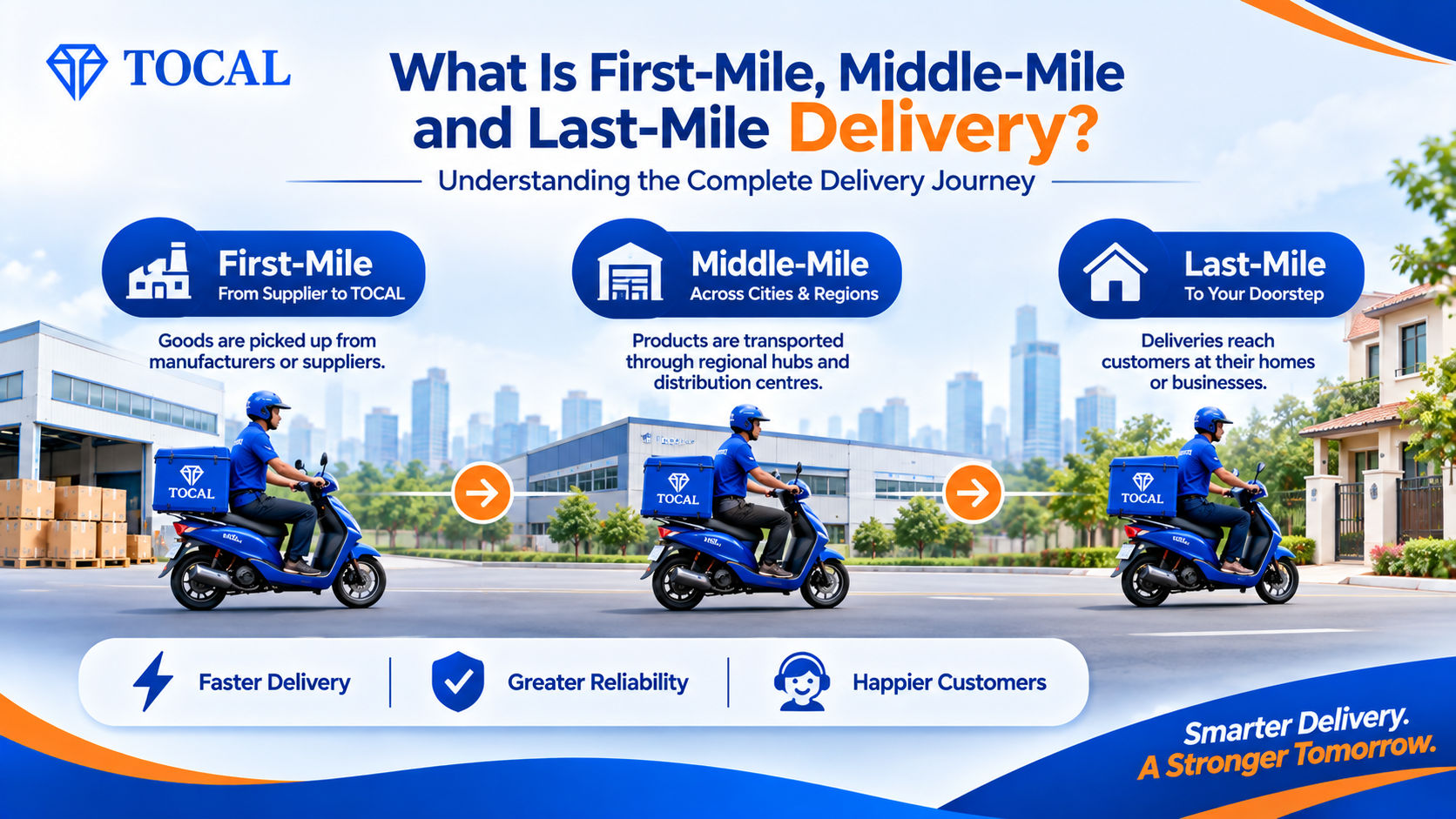
In logistics terms, a courier shipment usually passes through all three stages of delivery, while hyperlocal delivery often skips the middle mile. See first-mile, middle-mile and last-mile delivery and the last-mile delivery process.
How pricing usually differs
Prices vary by provider, so use these as patterns to ask about, not as fixed rules:
- Couriers often price by parcel weight and destination zone, with extra charges for cash on delivery, remote areas or returns
- Hyperlocal providers often price by distance, delivery slot, order or a monthly arrangement for steady volumes
- Hidden costs matter in both: failed deliveries, re-deliveries, damage, returns and your own time
The right comparison is:
Cost per successfully delivered order = (delivery spend + failed-delivery and re-delivery cost + refunds from delay or damage + support effort) ÷ orders delivered successfully.
Run this on a sample of your own orders for each option.
Which should you choose? A decision guide
| Your situation | Better fit |
|---|---|
| Customer in the same city needs it today | Hyperlocal delivery |
| Customer in another city or state | Courier |
| Gifts, cakes, flowers or time-bound items inside the city | Hyperlocal delivery |
| Urgent documents or small items within the city | Hyperlocal delivery |
| Steady daily orders in one city | Hyperlocal delivery with a partner that works fixed zones |
| Nationwide customers with no urgency | Courier |
| Very heavy or oversized shipments between cities | Courier or freight options |
| A mix of local and out-of-city customers | Both, routed by pin code |
| Very few, irregular orders | On-demand riders or a courier, while you learn your demand |
Using both: a hybrid approach
Many online sellers do not choose one forever. They route each order automatically:
- Bengaluru pin codes in your hyperlocal zones: send by hyperlocal delivery, with a same-day or slot promise
- Other Bengaluru areas: hyperlocal with later cutoffs or next-day delivery
- Everywhere else: send by courier, with a standard delivery promise
Show the right promise at checkout based on the customer's pin code. For setup, see the delivery setup checklist for beginners.
Common myths and mistakes
- "Hyperlocal is always more expensive." Not necessarily. Faster delivery, fewer failures and less damage can make it better value for local orders
- "Couriers are always cheaper." Light parcels over long distances can be cheap, but returns, failed deliveries and slower speed add cost
- "Couriers cannot do same-day." Some offer it in selected cities, but timing and cutoffs vary by provider
- "Hyperlocal can ship anywhere." It is built for local routes
- Promising speed you cannot keep, whichever option you choose
- Choosing on headline price alone without measuring cost per delivered order
Questions to ask before you choose
For a hyperlocal provider
- Which areas and pin codes do you cover, and what cutoffs and slots can you support?
- Do I get riders in fixed zones, or a shared pool?
- What tracking and customer updates are included?
- How do you handle failed deliveries, COD and returns?
- How do you plan for peaks and rain?
For a courier
- Which pin codes do you serve, and what are the typical timelines on my routes?
- How are charges calculated: weight slabs, zones, COD, returns and remote areas?
- When are pickups, and how are missed pickups handled?
- What is your remittance cycle for COD?
- How do you handle damage, loss and claims?
Agree measurable targets with either, using last-mile delivery SLAs.
Hyperlocal delivery vs courier in Bengaluru
Bengaluru is a large, dense city where most online orders are placed by customers in clusters such as Koramangala, HSR Layout, Indiranagar and Whitefield. That makes hyperlocal delivery very effective for local sellers: short routes, fast delivery and many repeat customers. At the same time, traffic on corridors like ORR and sudden rain can slow any route, so realistic windows and local knowledge matter.
- For customers in Bengaluru, hyperlocal delivery usually beats a courier on speed and control
- For customers outside the city, a courier is the practical choice
- For apartment-heavy zones, check how each provider handles gate access (see gated community deliveries)
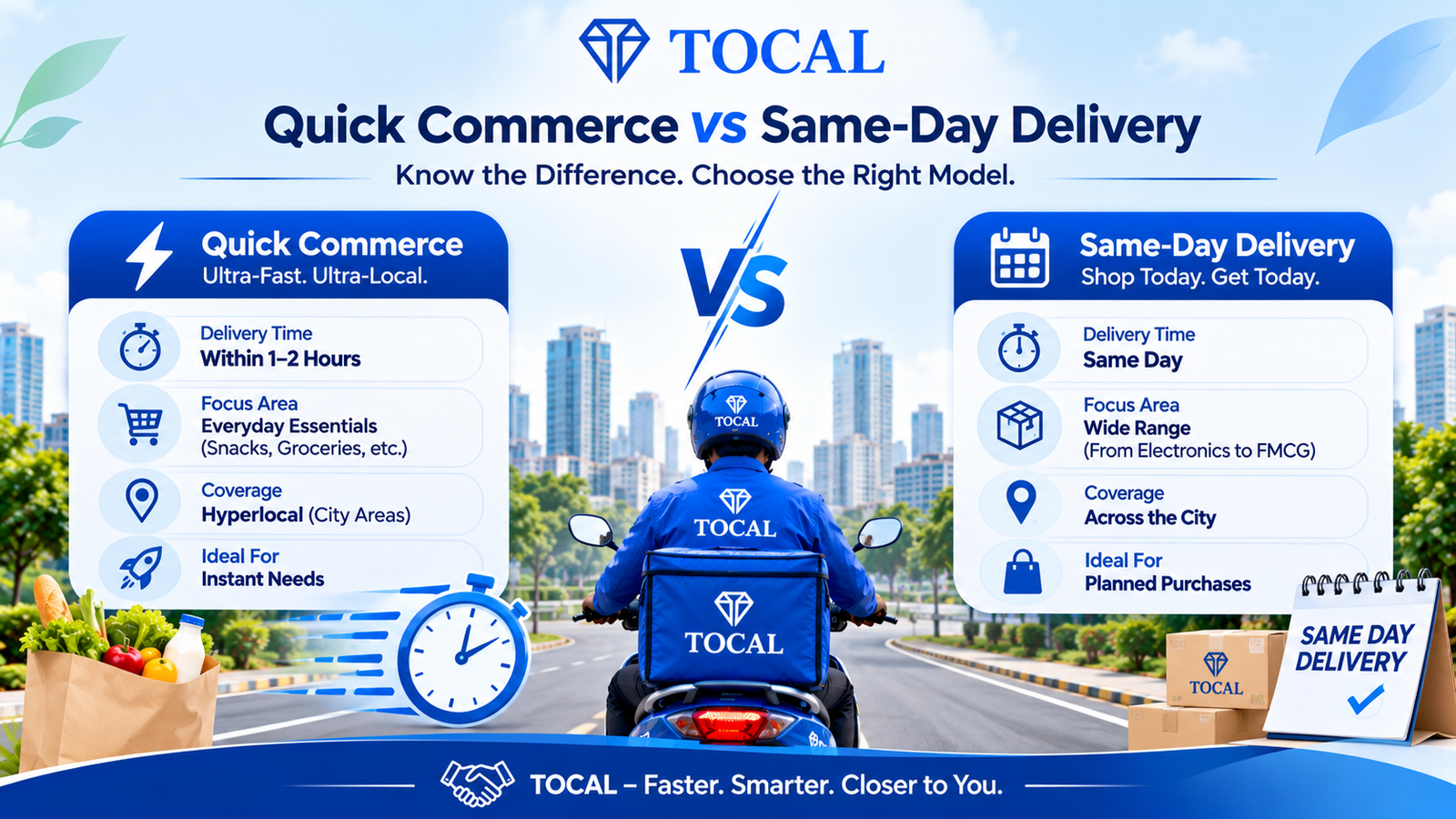
- For speed models inside the city, compare same-day delivery and quick commerce
Want to see a local example? Read delivery service in Koramangala.
Metrics to compare any delivery option
- Delivery time, from pickup to doorstep
- On-time delivery rate against the promised window
- First-attempt delivery success and failed delivery rate
- Damage and complaint rate
- Cost per successfully delivered order
- Support quality: how quickly problems get a response
New to these terms? Check the last-mile logistics glossary.
How TOCAL fits in
TOCAL focuses on hyperlocal delivery for same-day delivery within Bengaluru and last-mile delivery on an EV-only fleet, with fulfilment centers and EV fleet rentals. For orders outside the city, sellers typically combine local delivery with a courier. Our approach follows three steps:
- Understand: we analyse your order volumes, delivery zones and SLA requirements
- Deploy: we put the right fleet, trained delivery partners and operations team in place
- Manage, track and scale: we monitor performance live and scale capacity up or down as your volumes change
With 98%+ on-time delivery, 30 lakh+ green deliveries completed and 35+ brands served, TOCAL supports D2C brands, retail and FMCG, SMEs and individual sellers and enterprises and quick commerce.
Frequently asked questions
What is the difference between hyperlocal delivery and courier?
Hyperlocal delivery moves orders within a city or small area, usually directly from a pickup point to the customer by a rider, often within hours. Courier delivery moves parcels through a network of hubs and linehaul transport, usually between cities, and typically takes days.
Is hyperlocal delivery faster than a courier?
Within a city, usually yes, because orders go on a short direct trip without hub sorting or long-distance transport. For deliveries to other cities, a courier is the practical option.
Is hyperlocal delivery more expensive than a courier?
Not always. Per order, hyperlocal can cost more for very light parcels, but it can be better value when you count speed, fewer failed deliveries and fewer damaged parcels. Compare options by cost per successfully delivered order for your own routes.
Can a courier do same-day delivery?
Some couriers offer same-day services in selected cities, but it depends on the provider, the area and cutoff times. Hyperlocal providers are built around same-day and short-window delivery within a city.
Can hyperlocal delivery be used for deliveries to other cities?
No. Hyperlocal delivery is designed for local routes. For other cities, sellers usually use a courier, and many combine both, routing orders by pin code.
Which is better for small online sellers in Bengaluru?
If most of your customers are in Bengaluru and speed or reliability matters, hyperlocal delivery is usually a better fit. If you ship across the country, use a courier for those orders. Many sellers use hyperlocal for the city and a courier for everything else.
How do I choose between hyperlocal delivery and courier for my business?
Look at where your customers are, how fast you need to deliver, parcel size and value, order volume, COD share and cost per delivered order. Then test each option on a small number of orders before committing.
Does TOCAL provide hyperlocal delivery in Bengaluru?
Yes. TOCAL provides hyperlocal delivery in Bengaluru for same-day delivery within the city, and last-mile delivery, on an EV-only fleet, serving D2C brands, retail and FMCG, SMEs and individual sellers, and enterprises.
Final thoughts
Hyperlocal delivery and courier services solve different problems. Hyperlocal is built for speed and control inside a city. Couriers are built for reach across the country. Look at where your customers are, how fast you need to deliver and what each option really costs per delivered order, then choose one, or combine both with simple pin-code routing.
Not sure which suits your business? Share your volumes, delivery areas and product type, and TOCAL will help you plan a setup that fits. Talk to a TOCAL Delivery Expert.