Last-mile delivery is the final stretch of an order's journey and the part your customer actually sees. It runs from the moment an order is placed to the moment it lands at the doorstep, through eight stages where things can go right or wrong. Here is how the process works, where it breaks and how to improve it in Bengaluru.
Quick answer
What is the last-mile delivery process? It is the series of steps that move an order from a store, warehouse or fulfilment centre to the customer's doorstep: order capture, processing and packing, dispatch planning, rider assignment, pickup, transit with tracking, doorstep handover with proof of delivery, and closure with reporting. Failed attempts and returns loop back into the same process.
Key takeaways
- Last-mile delivery is the most visible step for customers and often the most complex and costly for businesses.
- The process has eight stages, and delays in early stages, such as packing and dispatch, show up as late deliveries.
- Shorter distances, fixed zones, dedicated riders and live tracking make the process faster and more predictable.
- Track a few metrics, including on-time delivery, first-attempt success and cost per delivered order.
- The best process is simple: fewer handoffs, fewer vendors and clear accountability.
A customer clicks "buy" and waits. From their side, the journey looks simple. From yours, it is a chain of handoffs between your systems, your packing team, a rider, traffic, weather and, finally, a front door. Any weak link can turn a good order into a complaint.
This guide walks through the last-mile delivery process from order to doorstep, explains where it goes wrong and shows how businesses can make it faster, cheaper and more reliable.
What is last-mile delivery?
Last-mile delivery is the final leg of an order's journey, from a store, warehouse or fulfilment centre to the customer's doorstep. The distance may be short, but this leg usually accounts for a large share of delivery effort and cost because it involves many small, separate drops to different addresses.
It is also where customer experience is won or lost: the promised time, the condition of the product and the behaviour of the rider all shape how people feel about your brand.
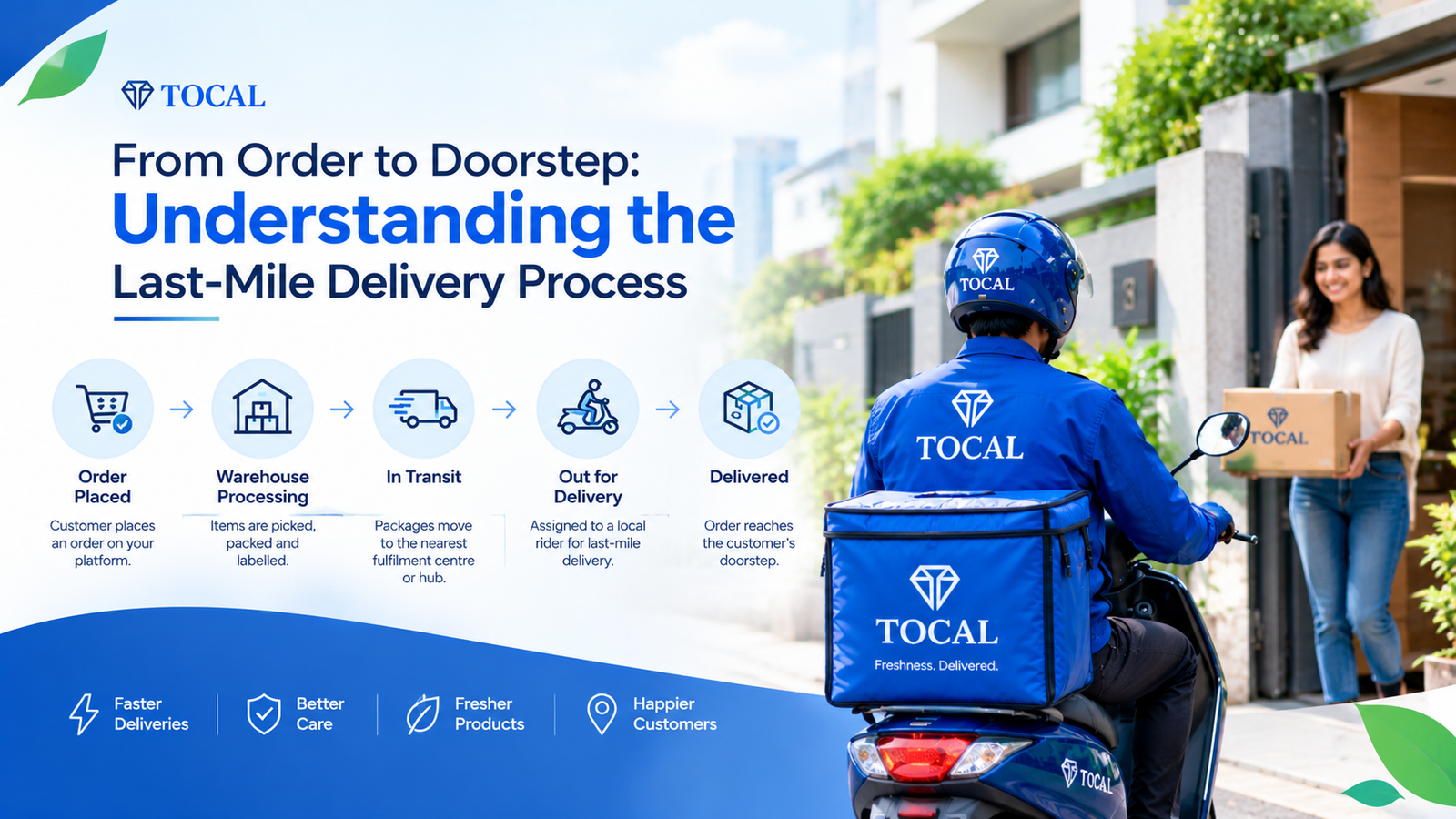
The last-mile delivery process: 8 stages from order to doorstep
| Stage | What happens | What can go wrong |
|---|---|---|
| 1. Order capture | The customer orders and selects a delivery window; address and details are validated | Incomplete or unclear addresses |
| 2. Processing and packing | The order is picked, packed and labelled at the store or warehouse | Packing delays, wrong or missing items |
| 3. Dispatch planning | Orders are grouped by zone and time slot into efficient routes | Poor clustering, long routes |
| 4. Rider assignment | A rider is assigned based on zone, availability and load | No rider available, especially at peaks |
| 5. Pickup | The rider collects the orders and confirms handover | Waiting time, mismatched orders |
| 6. Transit and tracking | The rider travels the route while location and status are tracked | Traffic, rain, wrong turns |
| 7. Doorstep handover | The rider delivers, collects payment if needed and records proof of delivery | Customer unavailable, address not found |
| 8. Closure and reporting | The order is closed; failures and returns are recorded; data is reported | Missing data, slow reconciliation |
The stages explained
Stage 1: Order capture
The process starts at checkout. Accurate addresses, phone numbers and realistic delivery windows set the foundation. Fixing a bad address here costs far less than a failed delivery later.
Stage 2: Processing and packing
Delivery speed starts inside your own four walls. A quick, accurate pick-and-pack, with clear labels and secure packaging, prevents most downstream delays and damage. Stock held closer to customers, such as in a fulfilment center, shortens everything that follows (see micro-fulfilment centres in Bengaluru).
Stage 3: Dispatch planning
Orders are grouped by zone and time slot so one rider can complete several drops efficiently. Good clustering cuts distance, time and cost per order.
Stage 4: Rider assignment
Matching orders to riders by zone and availability matters. Riders who know their area deliver faster and fail less often, which is why many businesses use dedicated delivery riders rather than a shared pool.
Stage 5: Pickup
Time lost at pickup is easy to overlook. Staged, packed orders sorted by zone let riders collect and go, instead of waiting while orders are found and packed.
Stage 6: Transit and tracking
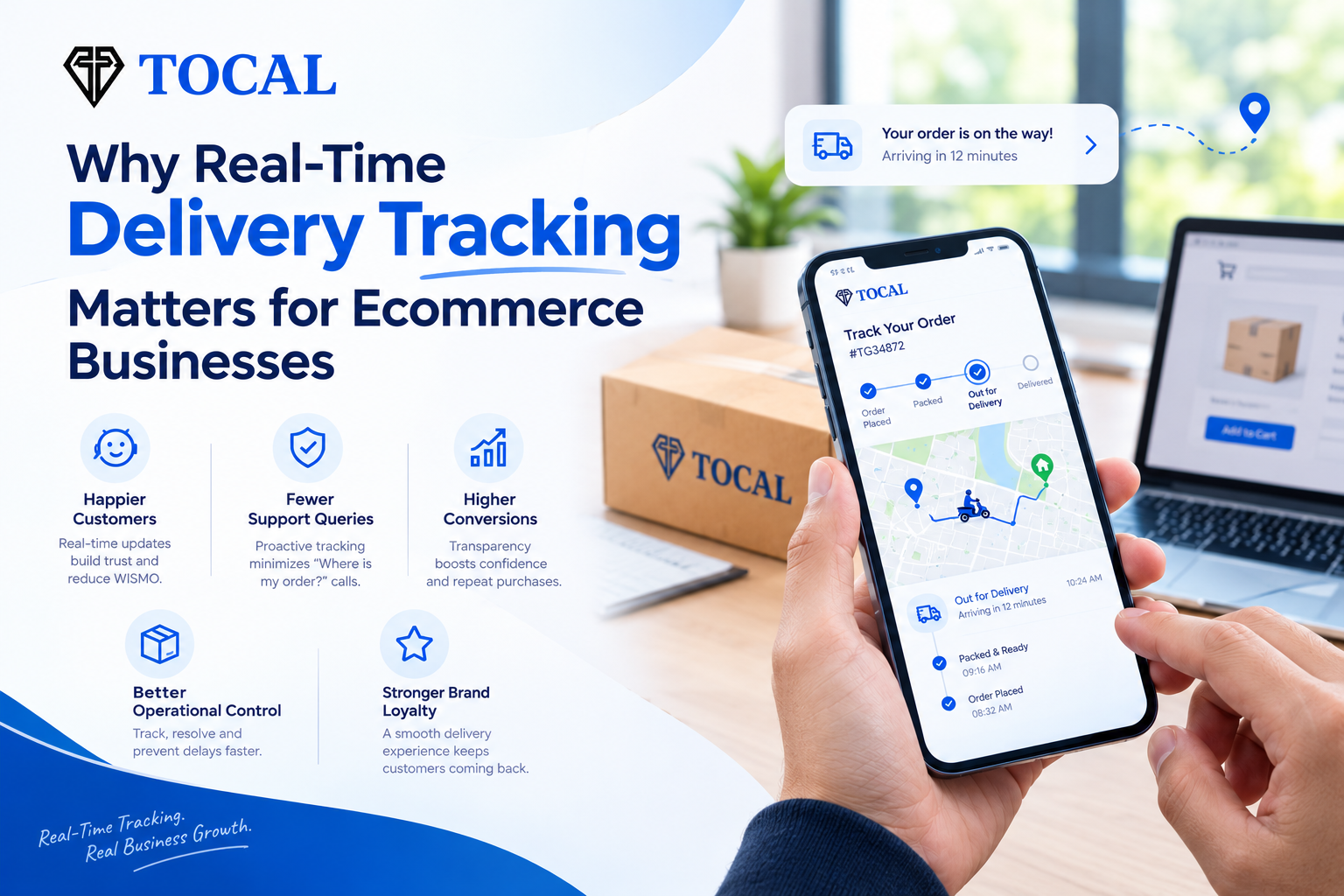
This is the stage customers watch. Live location, status updates and refreshed arrival estimates keep them informed and let your team catch delays early. Learn more in our guide to real-time delivery tracking for ecommerce.
Stage 7: Doorstep handover
The rider delivers the order, handles cash on delivery if applicable and records proof of delivery. If the customer is unavailable, a defined attempt policy and clear communication decide what happens next.
Stage 8: Closure and reporting
Every order ends with a recorded outcome: delivered, failed or returned. This data feeds your SLA reviews, cost analysis and improvements. Items that come back follow the flow described in our guide to reverse logistics for ecommerce.
Last-mile delivery is not one step. It is eight small handoffs, and the customer judges all of them as one experience.
Why last-mile delivery is so challenging
- Many small drops: each order goes to a different address, unlike bulk transport between hubs
- Unpredictable conditions: traffic, rain and road closures change arrival times quickly
- Address quality: unclear or incomplete addresses are a leading cause of failed deliveries
- Customer availability: people are not always home when the rider arrives
- High expectations: customers want speed, visibility and flexibility together
- Cost pressure: short distances still require a rider, a vehicle and time for every drop
Common last-mile challenges and how to fix them
| Challenge | Impact | Fix |
|---|---|---|
| Unclear addresses | Failed attempts and delays | Address validation at checkout, landmarks, contact confirmation |
| Long distances from stock | Slow, costly deliveries | Stock closer to customers through hubs and fulfilment centers |
| Inconsistent riders | Variable quality and delays | Dedicated riders in fixed zones |
| No visibility | Support calls, late problem detection | Live tracking and delay alerts |
| Peak-day overload | Missed delivery windows | Reserved base capacity plus flexible add-ons |
| Failed deliveries | Repeat trips and higher cost | Proactive customer updates, clear attempt policy |
Last-mile delivery models compared
| Model | How it works | Best for |
|---|---|---|
| In-house | You hire and manage riders and vehicles | Very large, stable operations with fleet management skills |
| Gig or app-based | Orders go to a shared pool of riders on demand | Occasional or unpredictable volumes and overflow |
| Dedicated fleet | A partner assigns trained riders and vehicles to your business | Steady daily volumes needing consistent quality |
| Hybrid | A dedicated base, flexible add-ons for peaks and apps for overflow | Growing brands balancing cost and reliability |
For a deeper comparison, read dedicated fleet vs delivery apps.
Last-mile vs hyperlocal vs same-day delivery
- Last-mile delivery is the final leg of any delivery, whatever the speed
- Hyperlocal delivery is last-mile delivery within a small area such as a neighbourhood or city, usually from a nearby store or hub
- Same-day delivery is a service promise, delivering on the day the order is placed, often enabled by hyperlocal operations
Learn how hyperlocal delivery and last-mile delivery work with TOCAL.
The technology behind a smooth last-mile process
- Order integration: order data flows automatically from your store or platform to the delivery partner
- Dispatch and clustering: orders grouped by zone and time slot
- Rider app: pickup confirmation, navigation, status updates and proof of delivery
- Tracking and notifications: live location, ETAs and customer messages
- Dashboards and reports: one view of active orders, delays and performance by zone
Metrics that show how healthy your last-mile process is
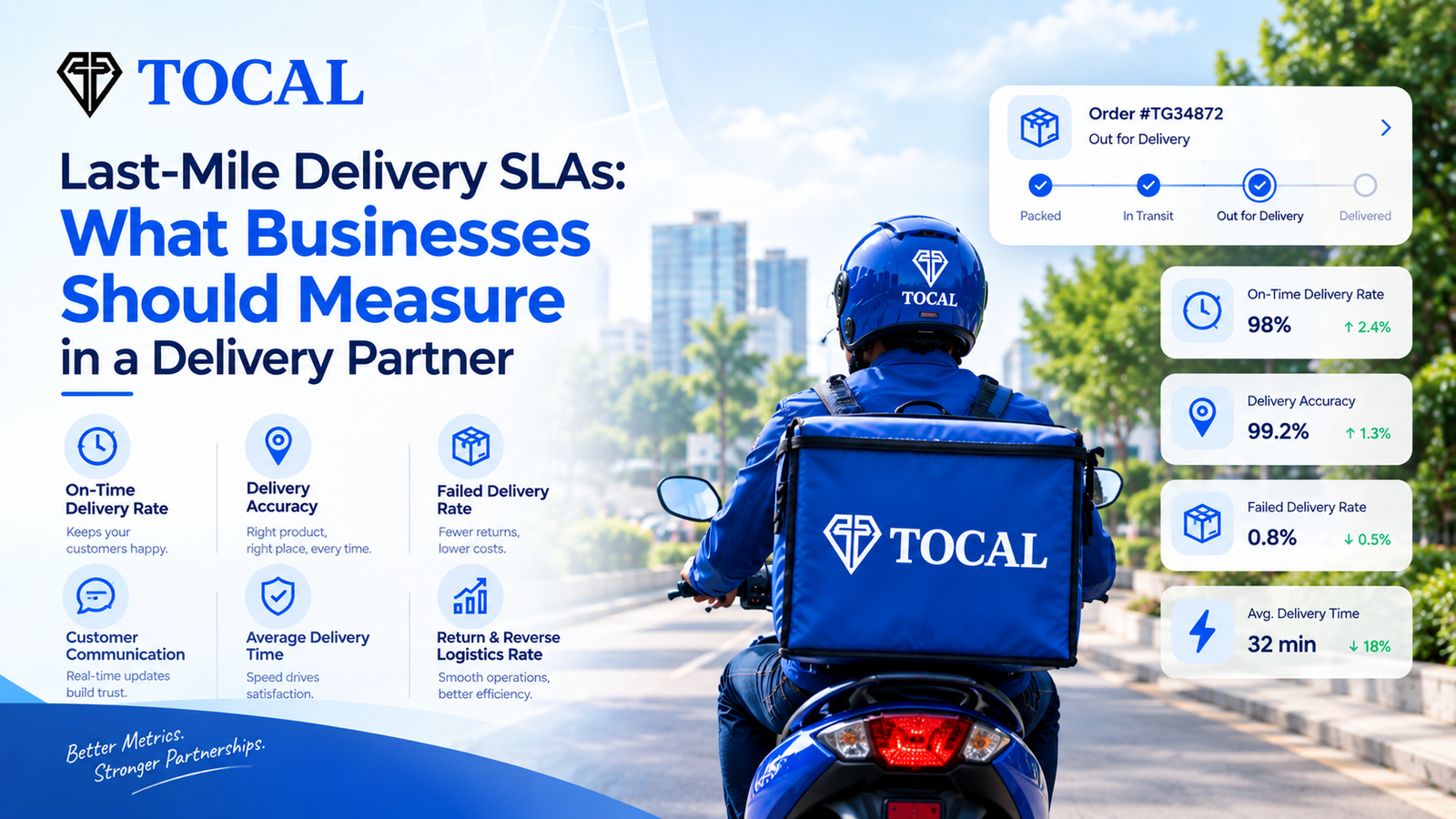
- On-time delivery rate, overall and by zone
- Pickup-to-dispatch time
- Average delivery time by zone and time slot
- First-attempt delivery success
- Failed delivery rate and top reasons
- Cost per successfully delivered order
- Customer complaints per 1,000 orders
Set clear targets for these with your partner. Our guide to last-mile delivery SLAs explains how.
Last-mile delivery in Bengaluru: what makes it unique
Bengaluru combines dense, fast-growing neighbourhoods such as Koramangala, HSR Layout, Indiranagar and Whitefield with congested corridors like ORR and sudden rain. That makes zone knowledge and short trips especially valuable.
- Use fixed zones, so riders learn lanes, landmarks and gated communities
- Cluster orders by area and time to cover more drops per trip
- Show realistic windows and update customers when conditions change
- Consider an EV-only fleet, which suits short, frequent urban trips (see EV delivery fleets and sustainability)
- Plan for peaks with the approach in our peak season delivery guide
How to improve your last-mile delivery process in 6 steps
- Map your current process from order to closure and time each stage
- Fix the biggest delay first, which is often packing, pickup waiting or dispatch
- Move stock closer to your busiest zones
- Use fixed zones and dedicated riders for steady volumes
- Add live tracking and automated updates for your team and customers
- Review a short scorecard weekly and adjust. For the bigger picture, see how to scale daily deliveries without extra complexity
How TOCAL runs the last mile for businesses in Bengaluru
TOCAL builds dedicated delivery infrastructure in Bengaluru around an EV-only fleet. Our approach follows three steps:
- Understand: we analyse your order volumes, delivery zones and SLA requirements
- Deploy: we put the right fleet, trained delivery partners and operations team in place
- Manage, track and scale: we monitor performance live and scale capacity up or down as your volumes change
With 98%+ on-time delivery, 30 lakh+ green deliveries completed and 35+ brands served, TOCAL supports D2C brands, retail and FMCG, SMEs and individual sellers and enterprises and quick commerce, through hyperlocal delivery, last-mile delivery, fulfilment centers and EV fleet rentals.
Frequently asked questions
What is last-mile delivery?
Last-mile delivery is the final leg of an order's journey, from a store, warehouse or fulfilment centre to the customer's doorstep. It is the most visible stage for the customer and often the most complex and costly for the business.
What are the stages of the last-mile delivery process?
The main stages are order capture, order processing and packing, dispatch planning, rider assignment, pickup, transit with tracking, doorstep handover with proof of delivery, and closure with reporting. Failed attempts and returns loop back into the process.
Why is last-mile delivery the most challenging part of logistics?
It involves many small deliveries to different addresses, unpredictable traffic and weather, customers who may be unavailable, imperfect address data and high customer expectations for speed and visibility.
How long does last-mile delivery take?
It depends on the delivery type and distance. Hyperlocal and same-day deliveries within a city can be completed within hours, while scheduled deliveries follow a chosen time slot. Shorter distances from stock to customer generally mean faster delivery.
What is the difference between last-mile and hyperlocal delivery?
Last-mile is the final leg of any delivery to the customer. Hyperlocal delivery is a type of last-mile delivery where orders are fulfilled and delivered within a small area, usually the same city or neighbourhood, often on the same day.
How can businesses improve last-mile delivery?
Standardise the process, place stock closer to customers, use fixed zones and dedicated riders, cluster orders, add live tracking and automated updates, and review a short set of metrics such as on-time delivery and first-attempt success every week.
Which metrics matter in last-mile delivery?
Key metrics are on-time delivery rate, pickup-to-dispatch time, average delivery time by zone, first-attempt delivery success, failed delivery rate, damage rate, cost per delivered order and customer complaints per thousand orders.
Does TOCAL provide last-mile delivery in Bengaluru?
Yes. TOCAL provides last-mile and hyperlocal delivery in Bengaluru with an EV-only fleet, trained delivery partners and live monitoring, serving D2C brands, retail and FMCG, SMEs and individual sellers, and enterprises.
Final thoughts
Understanding the last-mile delivery process is the first step to improving it. Map the eight stages, find where time and trust leak away, shorten the distance from stock to customer, use fixed zones and dedicated riders, and let live data guide your weekly reviews.
Want a simpler, more reliable last mile in Bengaluru? Share your expected volumes, service areas and SLA needs, and TOCAL will plan a delivery setup around your business. Talk to a TOCAL Delivery Expert.