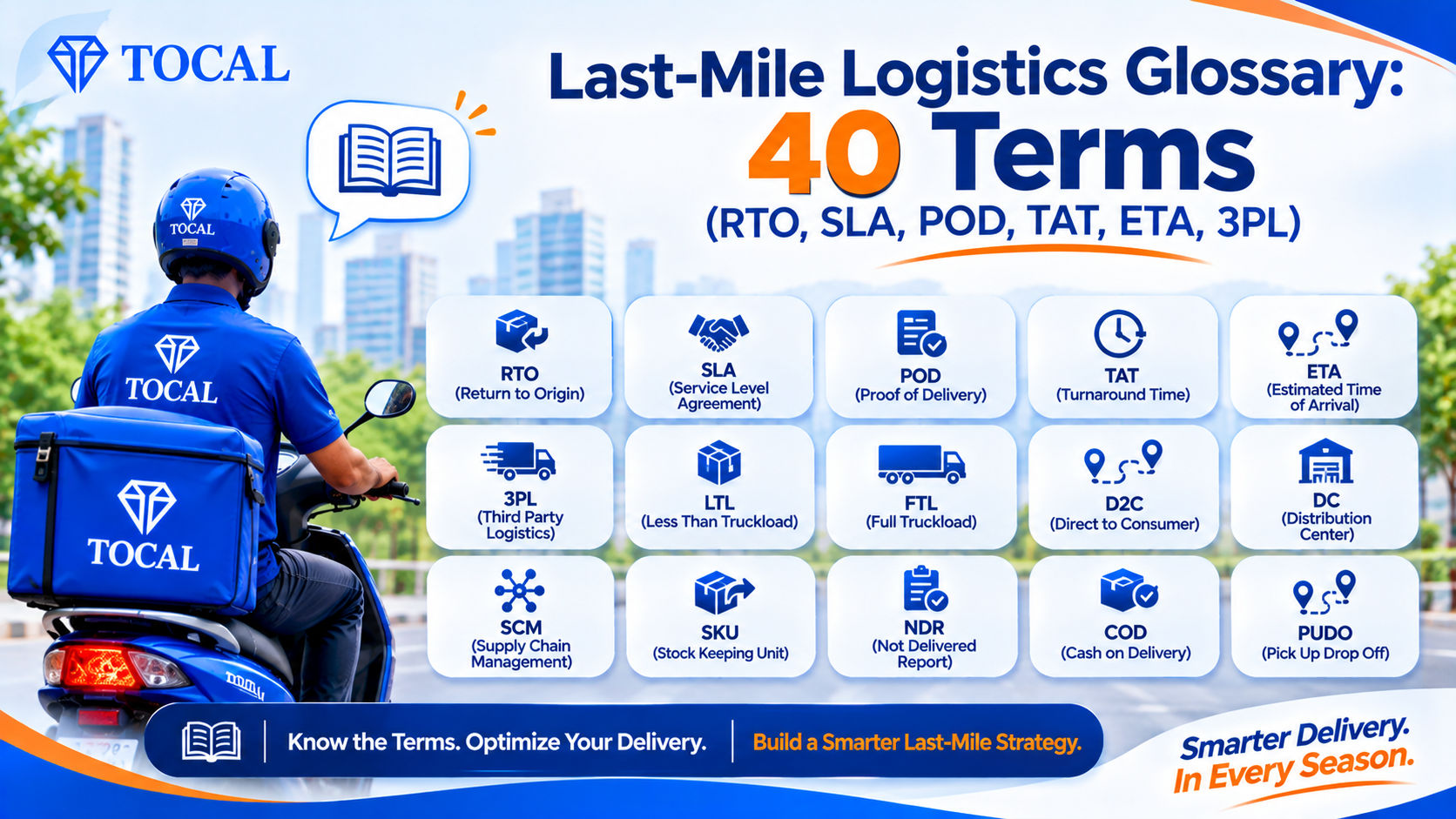
Last-mile logistics is full of abbreviations: RTO, SLA, POD, TAT, ETA, 3PL. This glossary explains 40 of the most important terms in plain English, with formulas where they help and links to deeper guides, so you can read delivery contracts, dashboards and reports with confidence.
Quick answer
What are the most important last-mile logistics terms? RTO (return to origin) is an undelivered order sent back to the seller. SLA (service level agreement) is the written set of delivery targets. POD (proof of delivery) is evidence of delivery. TAT (turnaround time) is the time a process takes. ETA (estimated time of arrival) is the predicted arrival time. 3PL (third-party logistics) is outsourcing logistics functions to a specialist provider.
Key takeaways
- This glossary covers 40 terms across five areas: delivery models, performance, failed deliveries and returns, dispatch and routing, and fleet and sustainability.
- Many terms are measured with simple formulas, such as on-time delivery rate and cost per delivered order.
- Always define where a clock starts and stops before agreeing a TAT, ETA or SLA.
- Each entry links to a deeper guide so you can go further when you need to.
Logistics teams, brands and delivery partners often use the same word to mean slightly different things. A clear shared vocabulary prevents disputes, makes SLAs enforceable and helps new team members get up to speed quickly.
Use this page as a reference. Bookmark it, share it with your operations and support teams, and come back whenever a term in a contract or report is unclear.
The six terms people search for most
| Term | Stands for | In one line |
|---|---|---|
| RTO | Return to origin | An undelivered order sent back to the seller |
| SLA | Service level agreement | Written, measurable delivery targets and remedies |
| POD | Proof of delivery | Evidence that the order reached the customer |
| TAT | Turnaround time | How long a defined process takes |
| ETA | Estimated time of arrival | When the delivery is expected to arrive |
| 3PL | Third-party logistics | A provider that runs logistics functions for you |
How to use this glossary
Terms are grouped into five sections. Jump straight to a term from the A to Z list below, or read a whole section to understand how the pieces fit together.
A to Z index: 3PL · COD · Cost per delivery (CPD) · Cutoff time · Dark store · Dedicated fleet · Delivery window · Dispatch · ETA · EV fleet rental · Failed delivery · First-attempt delivery success · First-mile delivery · Fulfilment centre · Geofencing · Hybrid capacity model · Hyperlocal delivery · KPI · Last-mile delivery · Live tracking (real-time tracking) · Micro-fulfilment centre (MFC) · Middle-mile delivery · NDR · On-demand fleet · Order batching · OTD · OTP delivery · POD · Quick commerce (q-commerce) · Reattempt · Reverse logistics · Reverse pickup (RVP) · Rider allocation · Route optimisation · RTO · Same-day delivery · Scope 3 emissions · SLA · TAT · Zone-based delivery
Delivery stages and models
First-mile delivery
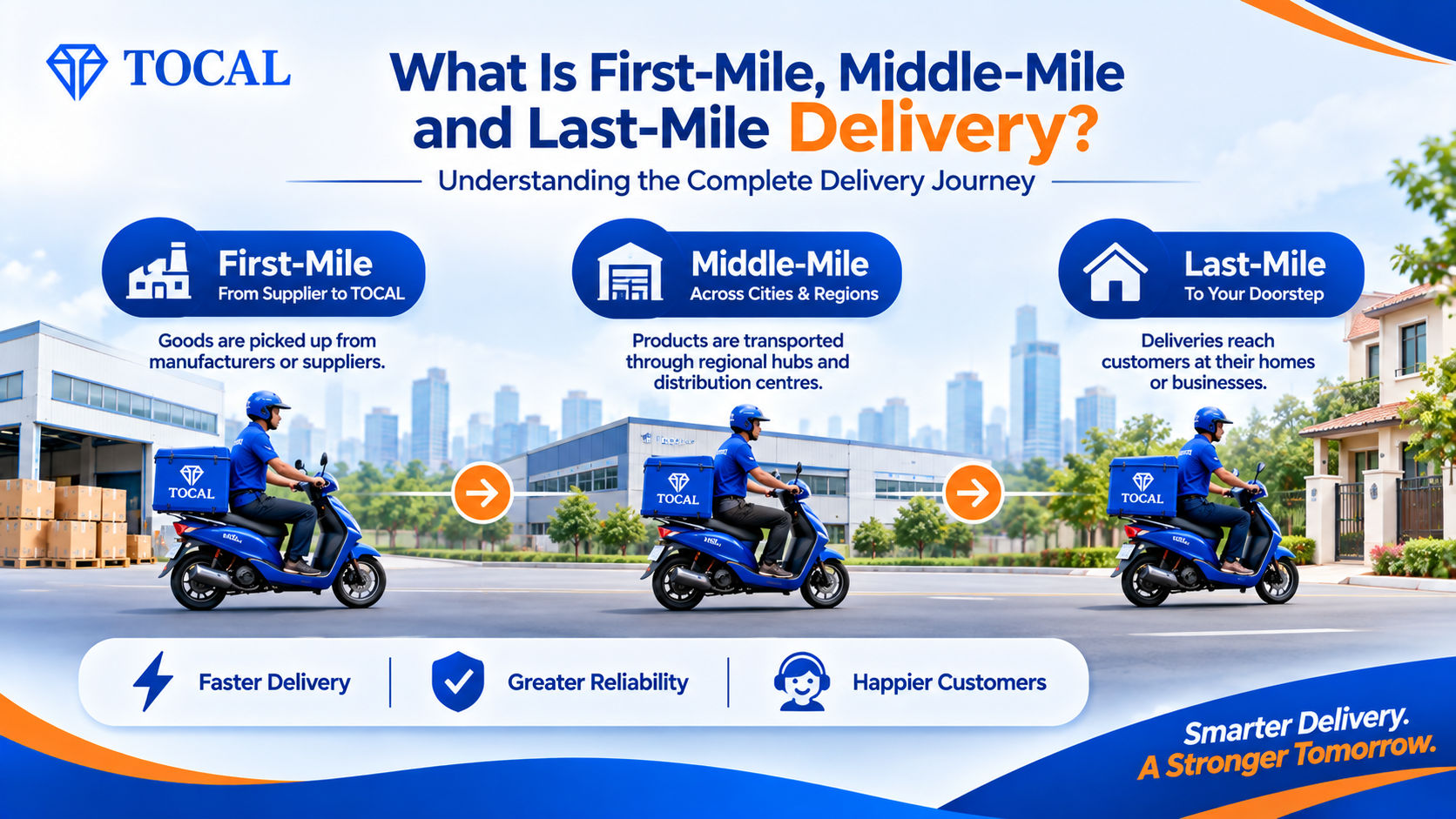
The first leg of a shipment's journey, where goods move from the seller, manufacturer or supplier to the first facility in the network, such as a warehouse or sorting hub.
Why it matters: Late or poorly prepared pickups delay everything that follows. Read more: first-mile, middle-mile and last-mile delivery
Middle-mile delivery
The bulk movement of goods between facilities, such as from a central warehouse to regional hubs or local delivery hubs, usually by trucks or larger vehicles.
Why it matters: Where stock is positioned decides how long this stage is, and how fast the last mile can be. Read more: first-mile, middle-mile and last-mile delivery
Last-mile delivery
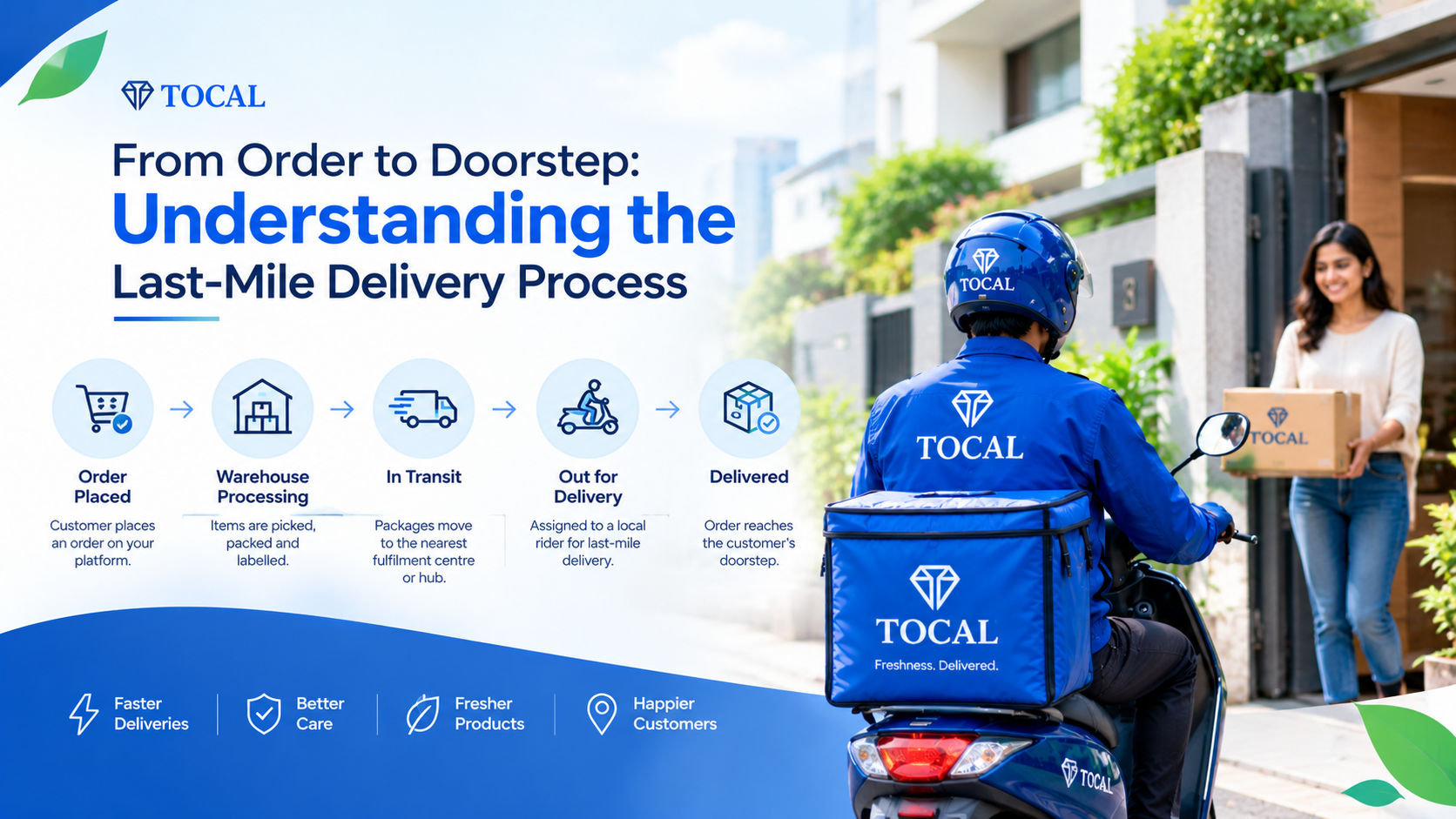
The final leg of a shipment's journey, from the last hub, store or fulfilment centre to the customer's doorstep.
Why it matters: It is the most visible stage for customers and often the most complex and costly per parcel. Read more: the last-mile delivery process
Hyperlocal delivery
Last-mile delivery within a small area, such as a neighbourhood or city, usually from a nearby store or hub and often on the same day.
Why it matters: Short distances make fast and same-day promises realistic. Read more: TOCAL hyperlocal delivery
Same-day delivery
A delivery service in which orders placed before a cutoff time arrive on the same day, usually in a chosen time slot.
Why it matters: It sits between quick commerce, which delivers in minutes, and standard shipping, which takes days. Read more: same-day delivery for online sellers in Bengaluru
Quick commerce (q-commerce)
An ecommerce model that delivers a limited range of products within minutes, commonly 10 to 30 minutes, from nearby micro-warehouses.
Why it matters: It needs dense, repeat demand and riders ready to leave the moment an order is packed. Read more: quick commerce vs same-day delivery
Dark store
A retail-style warehouse closed to walk-in shoppers and used only to pick, pack and dispatch online orders from a location close to customers.
Why it matters: Its layout and staffing are built for picking speed rather than browsing. Read more: what a dark store is
Micro-fulfilment centre (MFC)
A small, local fulfilment facility placed near dense demand zones to hold fast-moving stock and dispatch orders quickly.
Why it matters: It shortens the distance between stock and customer, which speeds up delivery. Read more: micro-fulfilment centres in Bengaluru
Fulfilment centre
A facility that stores inventory and handles the picking, packing and dispatch of orders on behalf of a seller.
Why it matters: Placing one near your customers reduces delivery time and cost. Read more: TOCAL fulfilment centers
3PL (third-party logistics)
The outsourcing of logistics functions such as warehousing, transport or fulfilment to a specialist provider instead of running them in-house.
Why it matters: A 3PL may cover several functions, while a last-mile partner focuses on the final delivery leg. Read more: TOCAL last-mile delivery
Service levels and performance
SLA (service level agreement)
A written commitment between a business and its delivery partner that defines measurable service targets, such as on-time delivery rate, timelines, reporting and what happens when targets are missed.
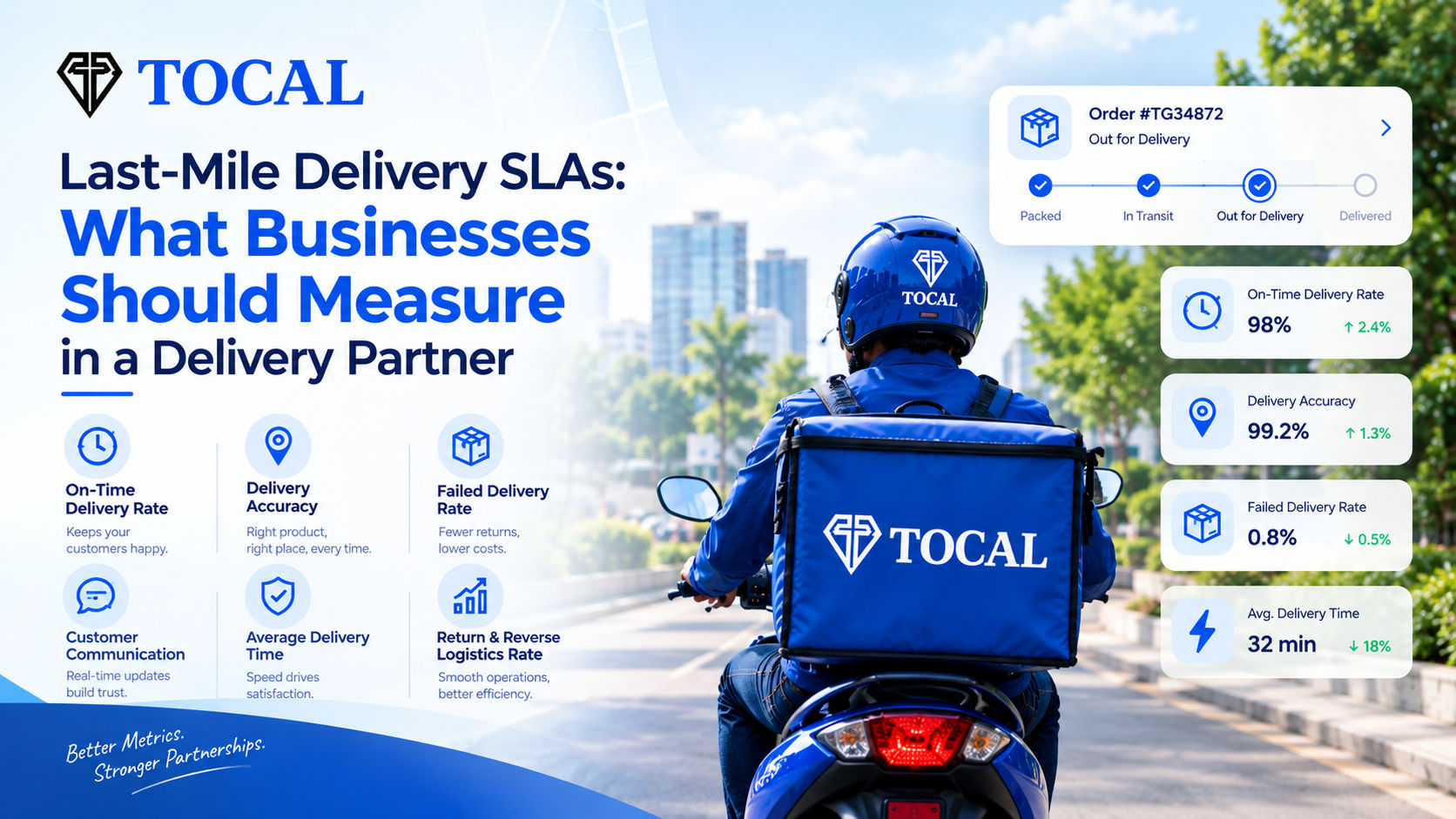
Why it matters: An SLA is only useful if each metric has a clear definition, a target and a way to be measured. Read more: last-mile delivery SLAs
KPI (key performance indicator)
A measurable value used to track performance against a goal, such as on-time delivery rate, first-attempt success or cost per delivery.
Why it matters: A short set of KPIs, reviewed weekly, is easier to act on than a long dashboard. Read more: last-mile delivery SLAs
TAT (turnaround time)
The time taken to complete a defined process, such as order-to-delivery, pickup-to-dispatch or return-to-restock.
Why it matters: Always state exactly where the clock starts and stops, otherwise two teams will measure different things. Read more: last-mile delivery SLAs
ETA (estimated time of arrival)
The predicted time at which a delivery will reach the customer, ideally refreshed as the trip progresses.
Why it matters: Accurate ETAs reduce support calls; showing a window instead of a single exact time keeps promises realistic. Read more: real-time delivery tracking
OTD (on-time delivery rate)
The share of orders delivered within the promised window, calculated as orders delivered on time divided by total orders delivered, multiplied by 100.
Why it matters: It is the headline SLA metric and should be reported by zone and time slot, not only overall. Read more: last-mile delivery SLAs
First-attempt delivery success
The share of orders delivered on the first attempt, calculated as orders delivered on the first attempt divided by total orders attempted, multiplied by 100.
Why it matters: Every failed first attempt means another trip, more cost and a less happy customer. Read more: how delivery companies handle failed deliveries and RTO
Delivery window
The time range promised to the customer for delivery, such as between 4 pm and 6 pm.
Why it matters: Realistic windows protect on-time performance, especially in rain and peak traffic. Read more: monsoon and traffic in Bangalore
Cutoff time
The latest time an order can be placed or packed to qualify for a particular delivery promise, such as same-day delivery.
Why it matters: Set it by working backwards from your last delivery slot, with a buffer for traffic and weather. Read more: same-day delivery for online sellers in Bengaluru
Cost per delivery (CPD)
The cost of delivering an order, best measured as cost per successfully delivered order: delivery spend plus failed-delivery, re-delivery, refund and support costs, divided by orders delivered successfully.
Why it matters: A low headline rate can hide costs from failures, damage and support effort. Read more: fixed delivery capacity vs on-demand fleet support
Failed deliveries, proof and returns
RTO (return to origin)
What happens when a shipment cannot be delivered to the customer, for example after failed attempts or refusal, and is sent back to the seller or warehouse it came from.
Why it matters: RTO costs the forward trip, the return trip, handling and often the sale itself. Read more: how delivery companies handle failed deliveries and RTO
NDR (non-delivery report)
A record raised when a delivery attempt fails, stating the reason, such as customer unavailable or incorrect address, so the seller can choose to reattempt, correct the address or return the order.
Why it matters: Clear reason codes make it possible to find and fix the causes of failure. Read more: how delivery companies handle failed deliveries and RTO
Failed delivery
A delivery attempt that does not result in the customer receiving the order, for example because nobody was available, the address could not be found or the customer refused.
Why it matters: Most failures come from a few causes that can be prevented at checkout. Read more: how delivery companies handle failed deliveries and RTO
Reattempt
A further delivery attempt after a failed one, governed by an agreed policy on the number of attempts and the gap between them.
Why it matters: Put the attempt policy in your SLA so everyone knows when an order becomes an RTO. Read more: how delivery companies handle failed deliveries and RTO
POD (proof of delivery)
Evidence that an order was delivered, such as a signature, OTP confirmation, photo, timestamp or geolocation record.
Why it matters: POD settles disputes quickly and supports cash reconciliation. Read more: the last-mile delivery process
OTP delivery
A delivery handed over only after the customer shares a one-time password, confirming that the right person received the order.
Why it matters: It adds security for valuable items and doubles as proof of delivery. Read more: the last-mile delivery process
COD (cash on delivery)
A payment mode in which the customer pays when the order arrives. It needs cash handling and reconciliation, and is commonly linked to higher refusal and RTO risk.
Why it matters: Confirming COD orders before dispatch helps reduce failed deliveries. Read more: how delivery companies handle failed deliveries and RTO
Reverse logistics
The movement of goods from the customer back to the seller for returns, exchanges, repairs or disposal.
Why it matters: Fast pickups, inspection and refunds protect both margins and customer trust. Read more: reverse logistics for ecommerce
Reverse pickup (RVP)
A pickup arranged at the customer's address to collect an item for return or exchange.
Why it matters: Pairing an exchange pickup with a forward delivery can save a trip. Read more: reverse logistics for ecommerce
Dispatch, routing and tracking
Dispatch
The stage where packed orders are released to riders, including grouping orders, sequencing stops and monitoring progress until delivery.
Why it matters: Many delays are decided at dispatch, before the rider leaves. Read more: rider allocation and dispatch
Rider allocation
The process of assigning each order to a specific rider based on location, zone, load, availability and vehicle.
Why it matters: Good allocation shortens pickups and avoids overloading some riders while others idle. Read more: rider allocation and dispatch
Order batching
Grouping several nearby orders into one rider trip to lower cost per delivery.
Why it matters: Batching must be limited for very fast promises, or early customers wait for later ones. Read more: rider allocation and dispatch
Route optimisation
Using data on order locations, delivery windows, traffic, weather and vehicle range to choose efficient routes and stop sequences, and to adjust them as conditions change.
Why it matters: The fastest route is not always the shortest one. Read more: rider allocation and dispatch
Zone-based delivery
Assigning riders to fixed geographic zones so they learn local lanes, landmarks and access points.
Why it matters: Local knowledge improves speed and first-attempt success. Read more: benefits of dedicated delivery riders
Geofencing
A virtual boundary drawn around a location or zone, used to trigger actions such as rider arrival alerts or zone-based assignment.
Why it matters: It automates updates and keeps riders working in the right areas. Read more: rider allocation and dispatch
Live tracking (real-time tracking)
Real-time visibility of a rider's location and an order's status from pickup to doorstep, usually through a customer tracking link and a business dashboard.
Why it matters: It cuts "where is my order" calls and lets teams catch delays early. Read more: real-time delivery tracking
Fleet, capacity and sustainability
Dedicated fleet
Riders and vehicles reserved for one business or a small set of accounts, working fixed zones and shifts under an SLA.
Why it matters: It gives consistent quality and capacity you can plan around. Read more: benefits of dedicated delivery riders
On-demand fleet
Riders or vehicles added only when needed, such as through shared delivery apps or short-term rentals.
Why it matters: It is flexible, but availability and consistency can vary at peaks. Read more: fixed delivery capacity vs on-demand fleet support
Hybrid capacity model
A setup that combines a dedicated base fleet, a flexible layer for planned peaks and on-demand overflow for unplanned spikes.
Why it matters: Most growing brands get the best balance of cost and reliability from a hybrid. Read more: fixed delivery capacity vs on-demand fleet support
EV fleet rental
The use of electric delivery vehicles for a set period without buying them, sometimes with riders, maintenance and charging support included.
Why it matters: It lets businesses switch to electric delivery without heavy upfront investment. Read more: EV fleet rental for delivery in Bengaluru
Scope 3 emissions
Indirect greenhouse gas emissions in a company's value chain, as defined in the GHG Protocol. Deliveries carried out by a logistics partner usually fall under Scope 3.
Why it matters: Choosing a lower-emission fleet is one of the most direct ways to reduce reported delivery emissions. Read more: green logistics in Bengaluru
How these terms fit together
A single order touches many of these terms. An order is placed before the cutoff time, packed at a fulfilment centre, released at dispatch and assigned through rider allocation. The rider follows an optimised route with live tracking and an ETA inside a promised delivery window. The handover is confirmed with POD. If it fails, an NDR is raised and a reattempt follows, ending in RTO if delivery is still not possible. Throughout, the SLA and KPIs show how well the operation performed. See the full journey in the last-mile delivery process from order to doorstep.
How TOCAL puts these terms into practice in Bengaluru
TOCAL builds dedicated delivery infrastructure in Bengaluru around an EV-only fleet, with hyperlocal and last-mile delivery, fulfilment centers and EV fleet rentals. Our approach follows three steps:
- Understand: we analyse your order volumes, delivery zones and SLA requirements
- Deploy: we put the right fleet, trained delivery partners and operations team in place
- Manage, track and scale: we monitor performance live and scale capacity up or down as your volumes change
With 98%+ on-time delivery, 30 lakh+ green deliveries completed and 35+ brands served, TOCAL supports D2C brands, retail and FMCG, SMEs and individual sellers and enterprises and quick commerce.
Frequently asked questions
What is last-mile logistics?
Last-mile logistics covers the final leg of an order's journey, from the last hub, store or fulfilment centre to the customer's doorstep. It includes dispatch, rider allocation, delivery, tracking, proof of delivery and handling of failed deliveries and returns.
What does RTO mean in logistics?
RTO stands for return to origin. It happens when a shipment cannot be delivered to the customer, for example after failed attempts or refusal, and is sent back to the seller or warehouse it came from.
What is an SLA in last-mile delivery?
An SLA, or service level agreement, is a written commitment between a business and its delivery partner that defines measurable targets such as on-time delivery rate, pickup and delivery timelines, reporting and remedies when targets are missed.
What is the difference between a 3PL and a last-mile delivery partner?
A 3PL, or third-party logistics provider, may handle several functions such as warehousing, transport and fulfilment. A last-mile delivery partner focuses on the final leg from a local hub or store to the customer's doorstep.
What is the difference between TAT and ETA?
TAT, or turnaround time, is the time taken to complete a defined process, such as pickup to dispatch. ETA, or estimated time of arrival, is the predicted time a delivery will reach the customer.
What is proof of delivery (POD)?
Proof of delivery is evidence that an order was delivered, such as a signature, OTP confirmation, photo, timestamp or geolocation record. It helps settle disputes and reconcile cash on delivery.
What is the difference between NDR and RTO?
An NDR, or non-delivery report, is raised when a delivery attempt fails and records the reason. RTO happens later if the order cannot be delivered after the agreed attempts and is sent back to the seller.
Does TOCAL provide last-mile delivery in Bengaluru?
Yes. TOCAL provides last-mile and hyperlocal delivery in Bengaluru with an EV-only fleet and trained delivery partners, supported by fulfilment centers and live performance monitoring.
Final thoughts
Shared language makes logistics easier. When your team and your delivery partner define on-time delivery, TAT, RTO and POD the same way, contracts are clearer, reports are comparable and problems are solved faster. Keep this glossary close, and use the linked guides when you want to go deeper on any term.
Need help turning these terms into a delivery setup that works? Share your volumes, zones and SLA needs, and TOCAL will plan it around your business. Talk to a TOCAL Delivery Expert.