Quick commerce promises minutes. Same-day delivery promises hours. Both beat standard shipping, but they need very different inventory, riders and costs. Here is how they compare, and a simple way to decide which model fits your business in Bengaluru.
Quick answer
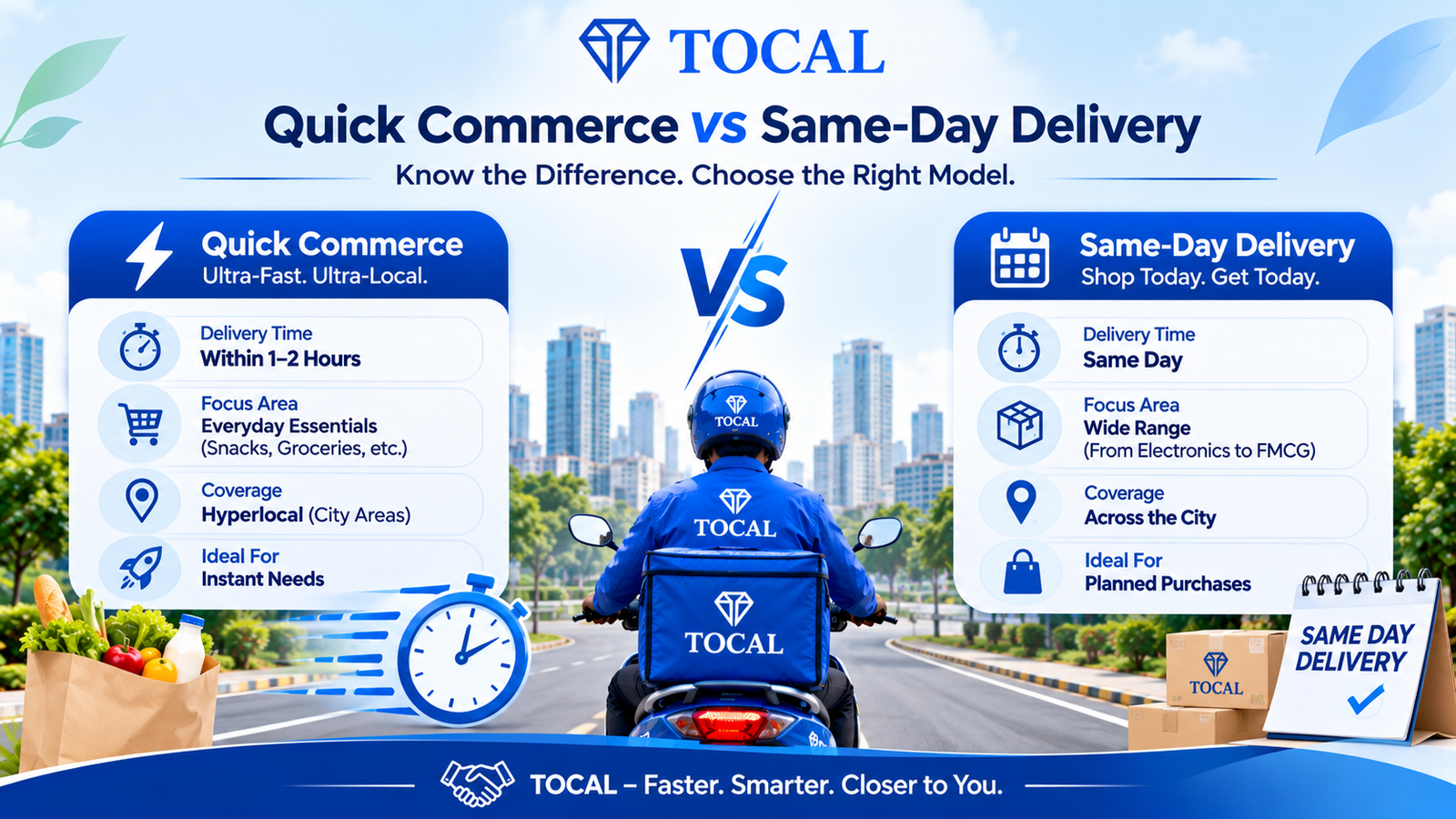
What is the difference between quick commerce and same-day delivery? Quick commerce delivers a limited range of products within minutes from nearby micro-warehouses or dark stores. Same-day delivery delivers orders placed before a cutoff later on the same day, usually from a wider range of stock in stores, warehouses or fulfilment centres. Quick commerce is faster but costlier and needs dense demand; same-day is broader, cheaper per order and easier to batch.
Key takeaways
- Quick commerce sells speed in minutes; same-day delivery sells convenience within the day.
- Quick commerce needs local stock, dense repeat demand and riders on standby; same-day can batch and plan routes.
- Most brands with wide catalogues should start with same-day and add express only where demand justifies it.
- A tiered promise (express, same-day, scheduled) is often the best answer.
- In Bengaluru, fixed zones, nearby hubs and live tracking matter more than headline speed.
Customers are getting used to faster delivery. For businesses, the question is no longer whether to speed up, but how far. Promising delivery in minutes can win loyalty, and it can also drain margins if the operation is not built for it.
This guide explains quick commerce vs same-day delivery, how they differ on speed, cost, inventory and riders, and how to choose the right model.
What is quick commerce?
Quick commerce (often called q-commerce) is an ecommerce model that delivers a limited range of products within minutes, commonly in the range of 10 to 30 minutes. Orders are fulfilled from small local warehouses, often called dark stores or micro-hubs, placed very close to customers.
It is built on a small catalogue of fast-moving items, very short delivery radii and riders positioned to leave the moment an order is packed.
What is same-day delivery?
Same-day delivery delivers orders placed before a cutoff time on the same day. Fulfilment happens from stores, warehouses or fulfilment centers, with delivery in a time slot or within a few hours. It can handle a much wider catalogue than quick commerce and tolerates larger and heavier orders.
Same-day delivery is usually delivered through hyperlocal delivery within a city, where stock sits close enough to reach customers within hours.
Quick commerce vs same-day delivery: side-by-side comparison
| Factor | Quick commerce | Same-day delivery |
|---|---|---|
| Delivery promise | Minutes | Within the day, often by time slot |
| Fulfilment source | Dark stores or micro-hubs very close to customers | Stores, warehouses or fulfilment centers across the city |
| Catalogue | Narrow, fast-moving items | Wide, including bulkier and slower items |
| Delivery radius | Very small | City-wide or large zones |
| Order size | Small, frequent baskets | Small to large, less frequent |
| Inventory approach | Stock duplicated across many local hubs | Fewer, larger stock points |
| Rider model | Riders on standby for instant dispatch | Riders dispatched in batches by zone and slot |
| Cost per order | Higher, needs dense demand to work | Lower, since orders can be batched |
| Best for | Groceries, essentials, impulse and urgent needs | Wider ranges, gifts, planned purchases and D2C catalogues |
What drives the cost difference
- Order density: quick commerce only works where enough orders arrive within a small radius to keep hubs and riders busy
- Rider idle time: instant dispatch means riders wait for orders, which costs money when demand dips
- Inventory duplication: stocking many local hubs ties up more stock and risks wastage on slower items
- Batching: same-day can group orders by zone and slot, spreading each trip across several drops
- Failed deliveries: under a tight promise, any failure or delay hurts more, so first-attempt success matters
Compare models by cost per successfully delivered order, including idle capacity, failed attempts and refunds, not only the per-trip rate.
Which business types fit which model?
| Business type | Usually a better fit | Why |
|---|---|---|
| Grocery, daily essentials and FMCG | Quick commerce (or fast same-day) | Frequent, small, urgent baskets and fast-moving items |
| D2C brands with wide catalogues | Same-day delivery | Less stock duplication and still faster than standard shipping |
| Gifting and occasion-based products | Same-day delivery | Customers plan ahead and value reliability over minutes |
| Fashion and lifestyle | Same-day delivery, with exchanges in one trip | Larger baskets and fit-related returns |
| SMEs and individual sellers | Same-day delivery | Lower volumes make dark-store models hard to sustain |
| Brands selling through quick-commerce platforms | Reliable replenishment to hubs | Platform speed depends on steady, on-time stock supply |
Five questions to decide
- Is my catalogue small and fast-moving? If yes, quick commerce is more realistic. If it is wide, start with same-day
- Do I have dense, repeat demand in specific zones? Quick commerce needs it; same-day is more forgiving
- Can I hold stock close to customers? Without nearby hubs, minutes-level delivery is not feasible
- Do customers truly need delivery in minutes? For many categories, a reliable same-day slot is enough
- Can my margins carry the extra cost? Model cost per delivered order before you promise speed
What each model needs to work
For quick commerce
- Micro-hubs or dark stores close to dense demand
- Real-time inventory so customers only see what is available
- Dedicated riders ready for instant dispatch in fixed zones
- Live tracking, tight packing processes and strong SLAs
For same-day delivery
- Clear order cutoff times and delivery slots
- A fulfilment point near your main demand zones
- Zone-based batching and dispatch planning
- Realistic windows, tracking and customer updates
Both depend on running the last-mile delivery process well, and on dedicated delivery riders who know their zones.
The middle path: a tiered delivery promise
You do not have to choose only one. Many businesses offer tiers:
- Express: a small set of fast-moving items in dense core zones, delivered in the shortest feasible time
- Same-day: a wider catalogue across the city, ordered before a cutoff
- Scheduled or next-day: everything else, or areas beyond your hyperlocal reach
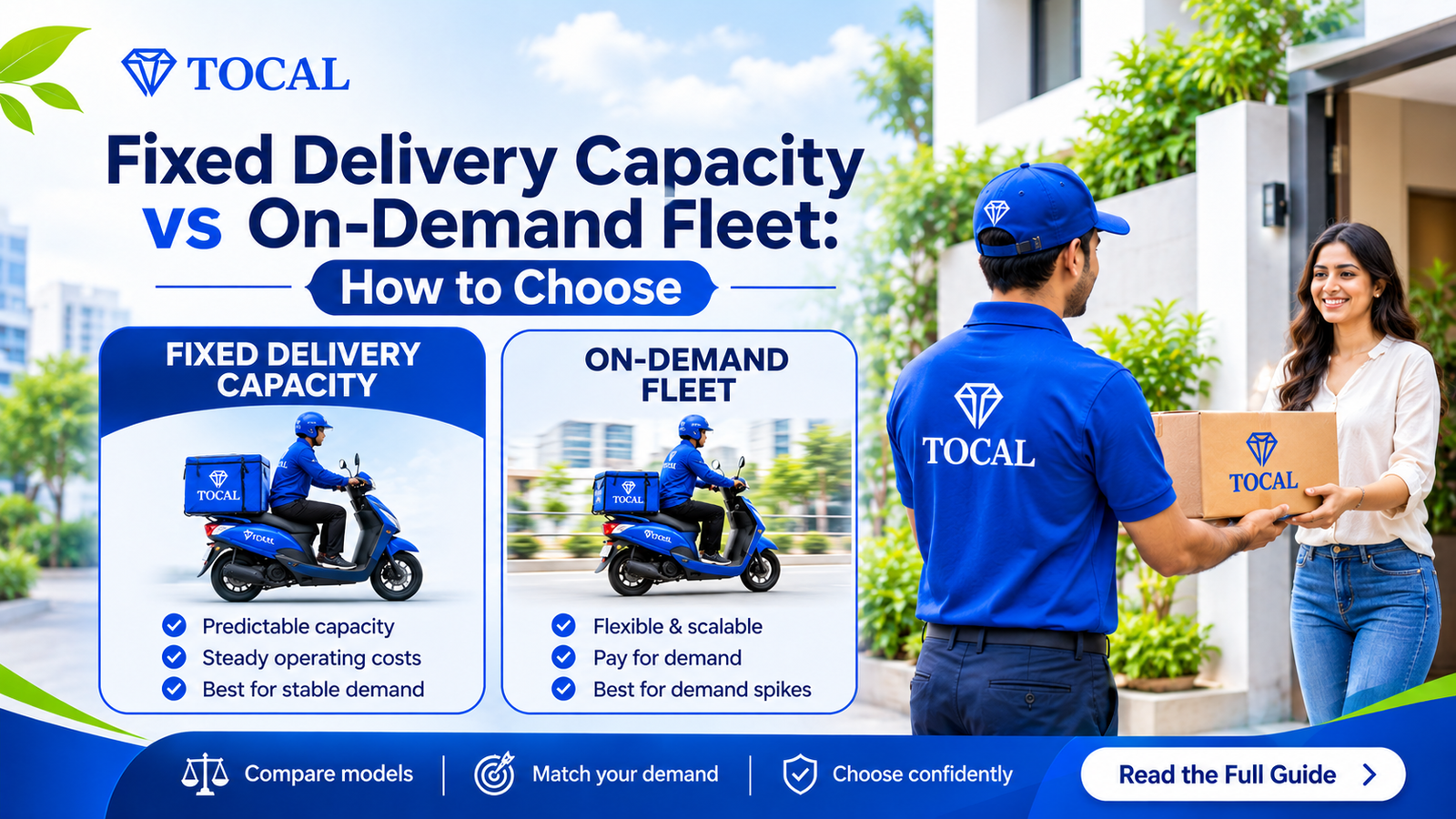
Start with same-day to learn your demand, then add express only in zones where order density and margins support it. Combine a dedicated base fleet with flexible capacity for peaks, as explained in fixed delivery capacity vs on-demand fleet support.
Promise the speed you can keep. A reliable same-day slot beats a missed 20-minute promise.
SLA metrics to set for each model
- On-time delivery rate, against the promised window
- Pickup-to-dispatch time: especially critical for quick commerce, where minutes matter
- Average delivery time by zone
- First-attempt delivery success
- Order accuracy and damage rate
- Rider availability at peak hours
Agree targets and reporting with your partner using the approach in our guide to last-mile delivery SLAs, and give customers visibility through real-time delivery tracking.
Quick commerce and same-day delivery in Bengaluru
Bengaluru's dense, high-demand neighbourhoods such as Koramangala, HSR Layout, Indiranagar and Whitefield suit hyperlocal delivery of both kinds. Short trips, stock close to customers and riders who know their zones all help.
- Traffic and rain on corridors like ORR can quickly break a minutes-level promise, so build buffers and update customers early
- Fixed zones and dedicated riders improve speed and first-attempt success
- Peak hours and festive periods need reserved capacity (see peak season delivery planning)
- EV fleets suit short, frequent trips and support your sustainability goals (see green logistics in Bengaluru)
How to test your delivery model in 5 steps
- Map demand by zone and hour, and find where orders cluster
- Pick one or two dense zones for a pilot
- Start with same-day, then test an express tier for a small set of items
- Measure cost per delivered order, on-time rate and first-attempt success
- Expand or adjust based on the data, adding hubs and riders only where it pays off. For the wider picture, see how to scale daily deliveries without extra complexity
How TOCAL supports quick commerce and same-day delivery in Bengaluru
TOCAL builds dedicated delivery infrastructure in Bengaluru around an EV-only fleet, with hyperlocal delivery for same-day delivery within the city and infrastructure for scale and speed for enterprises and quick commerce. Our approach follows three steps:
- Understand: we analyse your order volumes, delivery zones, product mix and SLA requirements
- Deploy: we put the right fleet, trained delivery partners and operations team in place
- Manage, track and scale: we monitor performance live and scale capacity up or down as your volumes change
With 98%+ on-time delivery, 30 lakh+ green deliveries completed and 35+ brands served, TOCAL supports D2C brands, retail and FMCG, SMEs and individual sellers and enterprises, through hyperlocal delivery, last-mile delivery, fulfilment centers and EV fleet rentals.
Frequently asked questions
What is the difference between quick commerce and same-day delivery?
Quick commerce delivers a limited range of products within minutes from nearby micro-warehouses or dark stores. Same-day delivery delivers orders placed before a cutoff time later on the same day, usually from a wider range of stock held in stores, warehouses or fulfilment centres.
How fast is quick commerce delivery?
Quick commerce usually promises delivery within minutes, commonly in the range of 10 to 30 minutes, from a very short distance. The exact promise depends on the operator, product category and location.
Is quick commerce more expensive than same-day delivery?
Often yes per order, because quick commerce needs dense demand, local stock, standby riders and very short delivery windows. Same-day delivery can batch orders and plan routes, which usually makes each delivery cheaper. Actual cost depends on volume and density.
Which is better for a D2C brand: quick commerce or same-day delivery?
Most D2C brands with wide catalogues and moderate order values start with same-day delivery, since it needs less stock duplication and still beats standard shipping. Quick commerce suits fast-moving, high-frequency products in dense zones, or brands selling through quick-commerce platforms.
What infrastructure does quick commerce need?
It needs micro-warehouses or dark stores close to customers, real-time inventory, dense and repeat demand, trained riders ready for short trips, live tracking and a tight operations team.
Can a business offer both quick commerce and same-day delivery?
Yes. A tiered promise works well: express delivery for a small set of fast-moving items in dense core zones, same-day delivery for a wider catalogue across the city, and scheduled or next-day delivery beyond that.
Which delivery model suits Bengaluru?
Bengaluru's dense, high-demand neighbourhoods suit hyperlocal models of both kinds. Rain and traffic on corridors such as ORR can affect promises, so realistic windows, fixed zones and live tracking matter more than the headline speed.
Does TOCAL support quick commerce and same-day delivery in Bengaluru?
Yes. TOCAL provides hyperlocal and last-mile delivery in Bengaluru on an EV-only fleet, including same-day delivery within the city, and serves enterprises and quick commerce businesses with dedicated delivery infrastructure.
Final thoughts
Quick commerce and same-day delivery are not rivals so much as points on a speed-and-cost spectrum. Start where your catalogue, demand density and margins make the promise sustainable, measure cost per delivered order, and add faster tiers only in the zones where they pay off.
Not sure which model fits? Share your product mix, volumes, service areas and SLA needs, and TOCAL will plan a delivery setup around your business. Talk to a TOCAL Delivery Expert.