Every small business that sells products reaches the same question: should I deliver orders myself, hand them to a courier or work with a delivery partner? Each option has a place. The right one depends on how many orders you have, where your customers are and how much of your own time you can afford to spend on the road. This guide helps you decide.
Quick answer
Should a small business use self-delivery, a courier or a delivery partner? Use self-delivery for a handful of local orders while you test demand. Use a courier for customers in other cities, when speed is not critical. Use a delivery partner, such as a hyperlocal provider with riders in fixed zones, for steady local orders where speed, reliability and your own time matter. Most small businesses move through these stages and end up with a hybrid.
Key takeaways
- Self-delivery looks free but costs your time, and it does not scale.
- Couriers offer wide reach; delivery partners offer speed and control inside a city.
- Compare options by cost per successfully delivered order, including your own time.
- Your stage matters: what suits 5 orders a week does not suit 50 orders a day.
- Switch gradually: pilot a zone, run in parallel and shift volume when the numbers hold.
In the early days, many founders deliver orders themselves: a bike, a bag and a few customers nearby. It feels thrifty, and it is a good way to meet customers. But there comes a day when delivery eats half your morning, a customer is angry about a late order and you realise you have stopped doing the work that grows the business.
This guide covers self-delivery vs courier vs delivery partner: how each works, how they compare, which fits your stage and business type and how to switch smoothly.
The three options explained
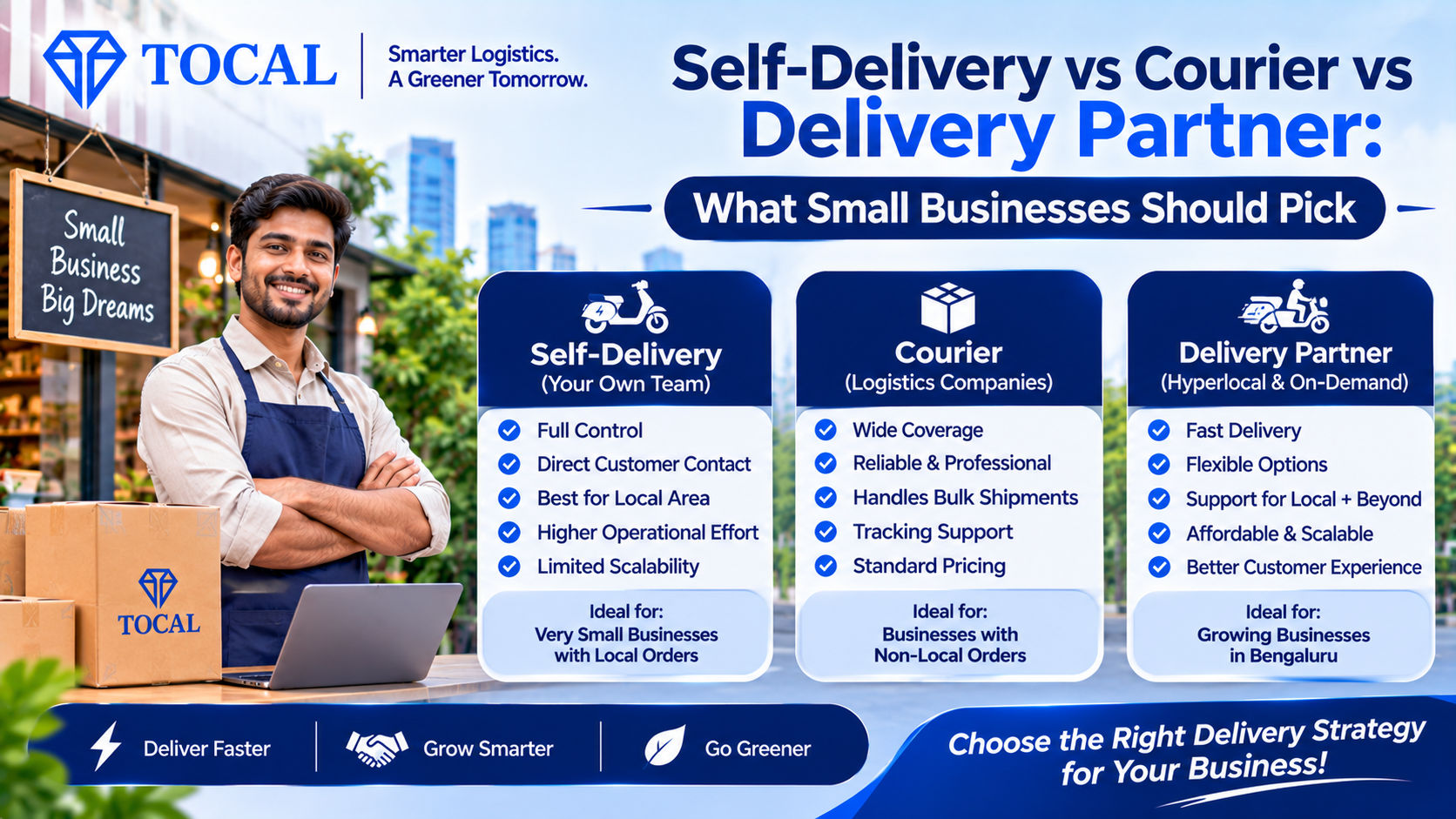
Self-delivery
You, a family member or a staff member carry orders to customers. You decide the routes and timing, and you meet customers face to face.
Courier
A courier company collects parcels and moves them through its network of hubs to customers, usually in other cities as well as locally. Pricing is typically based on weight and destination. See hyperlocal delivery vs courier for how couriers differ from local delivery.
Delivery partner
A delivery partner handles pickups and deliveries for your business using trained riders, often in fixed zones, with tracking, service levels and a named contact. Within a city, this is usually done through hyperlocal delivery. The partner acts like an extension of your own team.
Side-by-side comparison
| Factor | Self-delivery | Courier | Delivery partner |
|---|---|---|---|
| Setup effort | None | Low: sign up and book pickups | Moderate: agree zones, cutoffs and service levels |
| Cost structure | Fuel, vehicle wear and, mostly, your time | Per parcel, usually by weight and zone, plus extras such as COD | Per order, slot or volume arrangement, depending on the partner |
| Your time | High | Low | Low |
| Speed | As fast as you can ride, limited by your hours | Days for most routes | Hours within a city; same-day possible |
| Coverage | Tiny local area | Wide, often national | Within the partner's city zones |
| Scalability | Very low | High | High within the city |
| Control over experience | Complete | Low | Medium to high, with SLAs and trained riders |
| Tracking | Manual updates | Milestone-based tracking | Often live tracking and arrival alerts |
| Backup when you are unavailable | None | Built in | Built in |
| Peak-day handling | Breaks quickly | Depends; delays are common at peaks | Planned in advance with reserved capacity |
| Biggest risk | Burnout and inconsistent service | Slow or uncontrollable delivery for local orders | Needs forecasting and a clear agreement |
The hidden cost of self-delivery: your time
Self-delivery feels free because no invoice arrives. But your time has a price. Count it:
Real cost per self-delivered order = (fuel + vehicle wear + the value of your hours spent packing, riding and answering delivery queries + sales you missed while away) ÷ orders delivered.
- Missed opportunity: hours on the road are hours not spent on marketing, sourcing or customers
- No backup: if you are ill or travelling, deliveries stop
- Inconsistent service: late orders pile up on busy days
- No proof or tracking: customers ask where their order is, and you have only your memory to answer
How to compare real costs across the three options
Whatever you choose, use the same yardstick:
Cost per successfully delivered order = (delivery spend + packaging + failed-delivery and re-delivery cost + refunds from delay or damage + support effort + your own time) ÷ orders delivered successfully.
| Cost component | Self-delivery | Courier | Delivery partner |
|---|---|---|---|
| Direct delivery charge | Fuel and vehicle wear | Per parcel rate | Per order, slot or arrangement |
| Extra fees | None | COD, remote area and return fees | Depends on the agreement |
| Failed deliveries | Your time for repeat trips | Re-attempt policy and RTO charges | Re-attempt policy in the SLA |
| Damage and loss | Your risk | Claims process, often slow | Claims terms in the agreement |
| Your time and effort | High | Low to moderate | Low |
Compare quotes carefully, and ask exactly what each charge covers. For more on measuring success, see last-mile delivery SLAs.
Which option fits your stage?
| Stage | Typical situation | Suggested approach |
|---|---|---|
| 1. Testing | A few orders a week, mostly nearby | Self-delivery, plus a courier or on-demand rider for outliers |
| 2. Early traction | Several orders most days, a mix of local and out-of-city | Courier for other cities; on-demand riders or a delivery partner pilot for local orders |
| 3. Steady growth | Regular daily local orders and growing complaints about timing | Delivery partner for local orders, courier for the rest |
| 4. Scaling and peaks | Sales, festivals, multiple zones | Delivery partner with reserved capacity, courier for national, on-demand overflow |
The jump from stage 3 to 4 is covered in how to scale daily deliveries without increasing logistics complexity.
Which option fits your business type?
| Business type | Usually a good fit | Why |
|---|---|---|
| Boutique and fashion seller | Delivery partner locally, courier outside the city | Same-day gifts and exchanges matter; national orders can wait |
| Home baker or gifting business | Delivery partner or self-delivery with fixed slots | Time-bound, handling-sensitive orders |
| Handmade and craft seller | Courier, with strong packing | Customers are often across the country |
| D2C beauty or wellness brand | Delivery partner locally, courier elsewhere | Replenishment orders benefit from reliable timing |
| Local retail shop going online | Delivery partner, with self-delivery for a few regulars | Orders are mostly nearby and frequent |
| Small B2B supplier | Delivery partner for city accounts, courier or freight for others | Scheduled deliveries and clear proof matter |
Seven questions to decide
- Where are my customers? Mostly in one city points to a delivery partner; spread across the country points to a courier
- How fast do they expect delivery? Same-day expectations point to a delivery partner
- How many orders do I handle? A few a week can be self-delivered; steady daily orders cannot
- How valuable or fragile are my products? Higher value or fragility favours tracking, handling and proof of delivery
- Do I take cash on delivery? Check how each option handles COD collection and remittance (see failed deliveries and RTO)
- How much time can I spare? If delivery crowds out growth, it is time to hand it over
- What are my plans for the next six months? Sales, festivals and new areas call for capacity you can scale (see fixed capacity vs on-demand fleet support)
When to switch: signs you have outgrown your current option
- Delivery takes several hours of your day, most days
- Customers complain about late or missed deliveries
- Failed deliveries and re-trips are rising
- You cannot take a day off without orders stopping
- You want to offer same-day or evening slots
- A sale, festival or marketing push is coming
- You spend more time chasing couriers than serving customers
How to switch without disrupting orders
- Map your orders by pin code and time of day to find where a partner will help most
- Pilot one or two zones with a delivery partner, keeping your current method for everything else
- Run in parallel for a short period, so there is always a fallback
- Track results: on-time rate, failed deliveries, damage and cost per delivered order
- Move your core volume once the numbers are clearly better
- Keep a backup: a courier or on-demand rider for outliers and emergencies
Hybrid setups small businesses use
- Local plus national: a delivery partner for orders in your city and a courier for everywhere else, routed by pin code
- Partner plus overflow: a delivery partner for core volume and on-demand riders for sudden spikes
- Partner plus personal touch: a delivery partner for most orders, and self-delivery for VIP or special-occasion customers
Learn more about the logic in dedicated fleet vs delivery apps.
Mistakes small businesses make
- Self-delivering for too long, until growth is capped by your own hours
- Choosing on headline price without counting failed deliveries, returns and your time
- Using a courier for urgent local orders, then wondering why customers are unhappy
- Ignoring COD terms and remittance timelines
- No written terms on service levels, damage claims or fees
- Switching providers constantly, so nobody learns your business
- Not testing first with a small batch of orders
What to ask any delivery provider
- Which areas and pin codes do you cover, and what timelines can you promise?
- How are charges calculated, and what extras apply?
- How do you handle failed deliveries, returns and damage?
- What tracking and customer updates are included?
- How does cash on delivery work, and when do I get paid?
- What happens during peaks and rain?
- Who do I call when something goes wrong?
What this means in Bengaluru
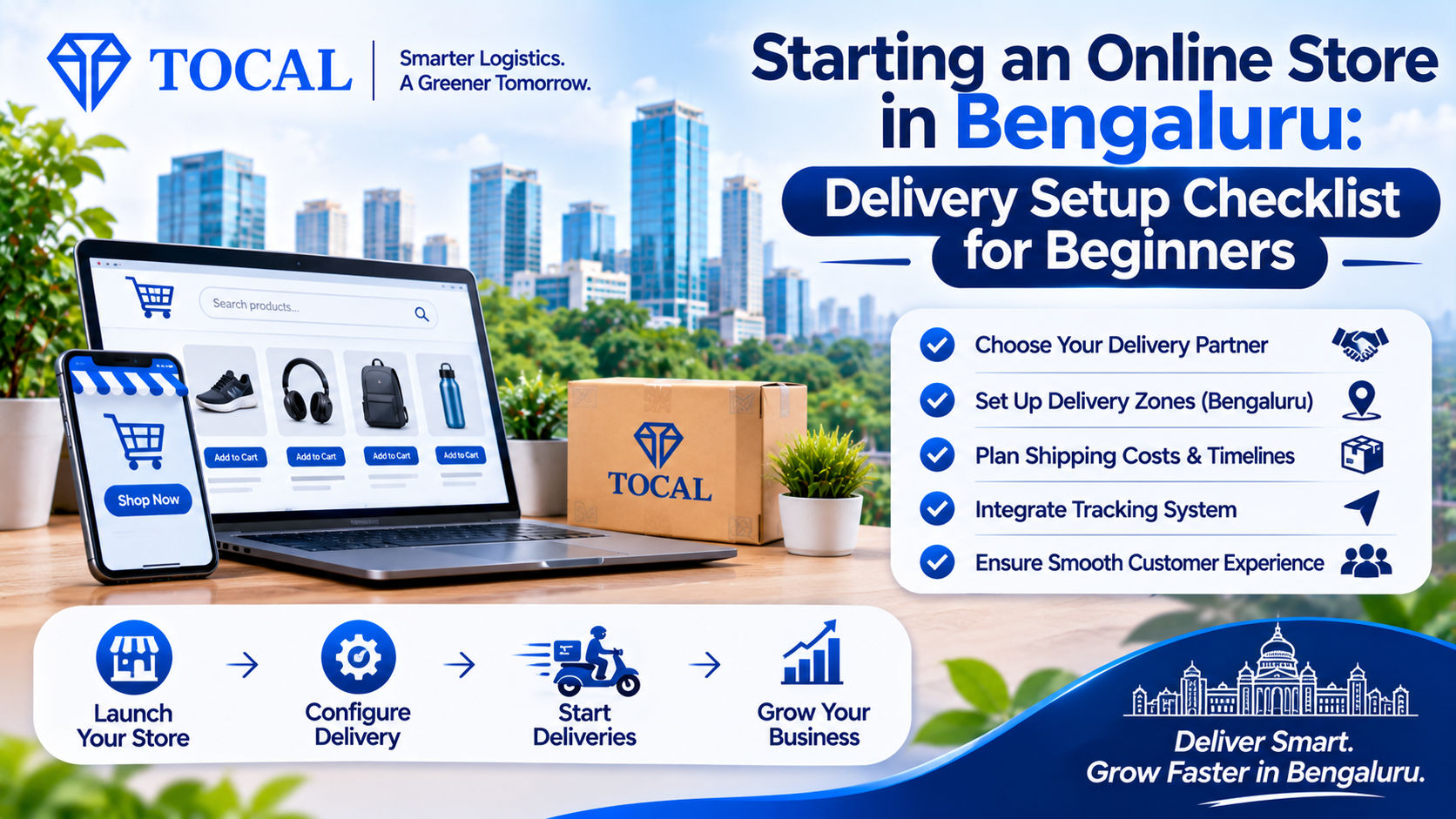
Most small businesses in Bengaluru have a large share of customers inside the city, in dense areas such as Koramangala, HSR Layout, Indiranagar and Whitefield. That makes local delivery partners a strong option once orders are regular, while couriers remain the answer for customers elsewhere. Traffic on corridors like ORR and sudden rain make self-delivery less predictable than it looks, so build buffers into your promises. New to setup? Start with the delivery setup checklist for beginners, and see same-day delivery in Bengaluru for online sellers.
How TOCAL helps small businesses in Bengaluru
TOCAL serves SMEs and individual sellers with enterprise-grade logistics sized for their business, built around an EV-only fleet. We offer hyperlocal delivery for same-day delivery within the city, last-mile delivery and fulfilment centers. Our approach follows three steps:
- Understand: we analyse your order volumes, delivery zones and SLA requirements
- Deploy: we put the right fleet, trained delivery partners and operations team in place
- Manage, track and scale: we monitor performance live and scale capacity up or down as your volumes change
With 98%+ on-time delivery, 30 lakh+ green deliveries completed and 35+ brands served, TOCAL also supports D2C brands, retail and FMCG and enterprises and quick commerce.
Frequently asked questions
Should a small business deliver orders itself?
Self-delivery works for the first few local orders, when you are testing demand and the area is tiny. Once orders become regular, it consumes your time, limits growth and makes service inconsistent, so most small businesses move to a courier or delivery partner.
When should a small business use a courier?
Use a courier for customers in other cities or states, when speed is not critical and when you need wide pin code coverage. Check weight-based pricing, cash on delivery fees, remittance timelines and return handling before you commit.
When does a delivery partner make sense for a small business?
A delivery partner makes sense when you have steady local orders, care about speed and reliability, want tracking and service levels and need to free your own time. It is especially useful for gifts, perishables and brand-sensitive products.
What is the real cost of delivering orders myself?
The visible costs are fuel and vehicle wear. The hidden costs are your time, missed sales while you are on the road, inconsistent service and no backup when you are unavailable. Count your time when you compare options.
Is a delivery partner more expensive than a courier for a small business?
Not necessarily. Compare by cost per successfully delivered order, including failed deliveries, damage, refunds and your own time. For local orders, a delivery partner can be better value, while a courier may be cheaper for light parcels sent far away.
Can a small business use more than one delivery option?
Yes. Many small businesses use a delivery partner for local orders and a courier for other cities, and keep occasional self-delivery for special cases. Route orders by pin code so each customer gets the right promise.
How do I switch from self-delivery to a delivery partner without disruption?
Pilot one or two zones first, run the partner in parallel for a short period, track on-time rate, failures and cost per order, and shift your core volume once the numbers hold. Keep self-delivery as a backup during the transition.
Does TOCAL work with small businesses in Bengaluru?
Yes. TOCAL serves SMEs and individual sellers alongside D2C brands, retail and FMCG, and enterprises, with hyperlocal delivery including same-day delivery within Bengaluru on an EV-only fleet. Share your volumes and areas and TOCAL will plan a setup sized for your business.
Final thoughts
There is no single right answer, only the right answer for your stage. Deliver yourself while you learn, use a courier to reach customers far away and bring in a delivery partner when local orders become regular and your time is worth more elsewhere. Measure cost per delivered order, switch gradually and keep a backup. The best delivery setup is the one that lets you grow without burning out.
Wondering whether it is time to hand over your deliveries? Share your volumes, delivery areas and product type, and TOCAL will plan a setup sized for your business. Talk to a TOCAL Delivery Expert.