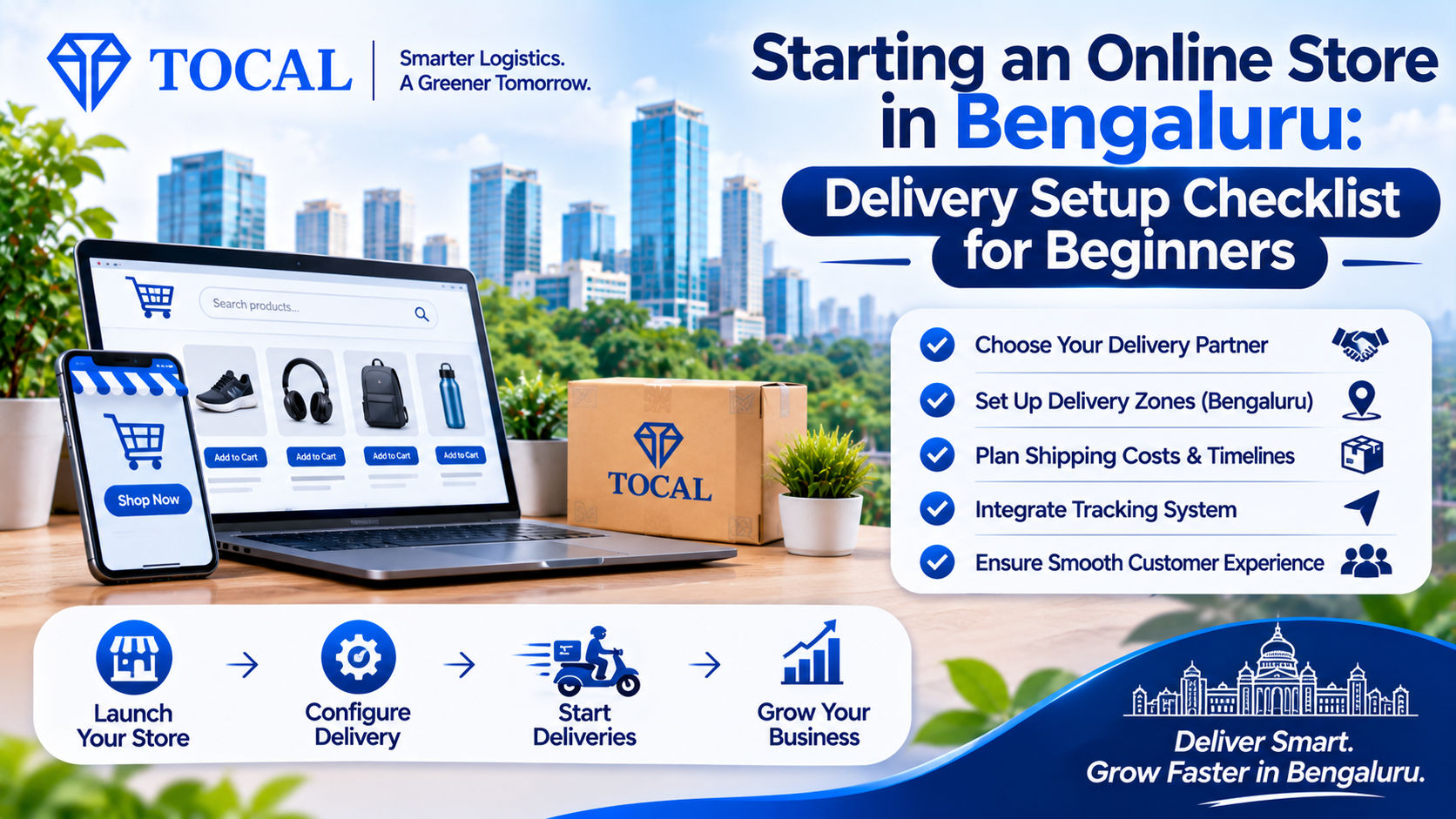
Most new online stores spend weeks on the website, the product photos and the ads, and only think about delivery when the first order arrives. In a city like Bengaluru, that is a costly order of work. This beginner checklist walks you through everything to set up before you launch, so your first customers get their orders on time and in good shape.
Quick answer
How do you set up delivery for a new online store in Bengaluru? Define your delivery promise and coverage area, pick a delivery model (self-delivery, a delivery partner or a mix), prepare packaging and labels, set up tracking and customer updates, plan for returns and failed deliveries, work out your cost per delivery, and test with real orders before launch. The checklist below covers each step in order.
Key takeaways
- Decide your delivery promise first. Everything else (model, packaging, pricing) follows from it.
- Self-delivery suits the first few orders a day in a small area. A delivery partner suits growth and wider coverage.
- Packaging, labels and clear customer updates prevent most early complaints.
- Know your real cost per delivery, including packaging, failed attempts and returns.
- Always test with real addresses across the city before you go live.
Delivery is the part of your store that the customer actually touches. A good product that arrives late, crushed or without any updates leads to bad reviews and lost repeat orders. A good setup does not need a big budget. It needs the right decisions made in the right order.
Use the sections below as a working checklist. You can tick off each item as you go.
Why delivery setup matters from day one
- Delivery shapes the customer's view of your brand: the parcel at the door is often the first physical contact with your store
- Early habits are hard to change: promises you make in week one (free delivery, same-day) become expectations
- Bengaluru is large and spread out: an order to one neighbourhood can take very different effort than one to another, so coverage needs planning
- Mistakes are cheaper to fix before launch: a test batch costs far less than a month of unhappy customers
Step 1: Define your delivery promise
Before you choose a vehicle, a partner or a packaging box, decide what you are promising the customer. Write it in one line you could put on your product page, for example "delivered within the city the same day for orders before noon" or "delivered in two days".
- Speed: same-day, next-day or scheduled slots
- Reliability: what you will do if you miss the promise
- Cost to the customer: free, flat or based on distance
- Product needs: fragile, perishable, high-value or bulky items change what is possible
Promise only what you can keep. It is easier to improve a modest promise than to repair a broken one.
Step 2: Map your coverage area
New stores often say "we deliver across Bengaluru" without checking what that means in practice. Start smaller and widen as you learn.
- List the areas and pincodes where your first customers are likely to be (your own network, nearby neighbourhoods and where your ads will run)
- Group them into zones, such as core, extended and not yet served
- Decide whether delivery time and fees differ by zone
- Show serviceable pincodes clearly on your website so customers know before they order
Step 3: Choose your delivery model
There are three common ways a beginner can deliver. None is right for everyone, and many stores change model as they grow.
| Model | Works well when | Watch out for |
|---|---|---|
| Self-delivery | You have a few orders a day, in a small area, and want full control | Your own time, no backup when you are unavailable, and no tracking for customers |
| Delivery partner | Orders are growing or spread across the city and you need reliability and tracking | You must check coverage, service levels, pricing and how issues are handled |
| Mix of both | You deliver nearby orders yourself and hand farther or higher-volume orders to a partner | Two processes to manage and a risk of inconsistent customer experience |
If you expect volume to change a lot, read about fixed capacity vs on-demand fleet support before you commit. If you are weighing your own electric vehicles, see EV fleet rental for delivery in Bengaluru.
Step 4: Get your packaging and labelling right
Packaging protects the product, represents your brand and affects how smoothly a rider can carry and hand over the parcel.
- Protect the product: use sturdy boxes or pouches and cushioning that suit your item. Test with a drop and shake check.
- Keep it right-sized: oversized boxes waste material and are harder to carry on two-wheelers
- Seal it clearly: a tamper-evident seal builds trust
- Label every parcel: order number, customer name, full address with landmark, phone number and any special instructions
- Handle special items: mark fragile goods, and plan separately for items that need temperature care
- Include the invoice: keep a printed or digital invoice ready, as required for your business
Step 5: Prepare your paperwork and basic compliance
Requirements depend on what you sell and how your business is registered, so confirm the details with your accountant or the relevant official sources. Common items to review include:
- Business registration and tax registration that apply to your business
- Licences or registrations specific to your product category (for example, food products)
- Correct invoicing for every order
- A clear policy for returns, refunds and cancellations on your site
- Terms of delivery shown at checkout
This is general information and not legal or tax advice.
Step 6: Set up order tracking and customer updates
Most "where is my order?" messages can be avoided by telling customers what is happening before they ask.
- Confirm the order straight after payment
- Send an update when the order is packed and when it is picked up
- Share a tracking link or rider contact where possible
- Send a message when the delivery is near and another on completion
- Make it easy to reach you if something goes wrong
If you use a partner, ask what tracking and updates they provide and how that data reaches your store or your customer.
Step 7: Plan for failed deliveries and returns
Every store has some deliveries that do not go to plan. Decide your rules now, not when the first case arrives.
- Customer not available: how many attempts, and what happens after the last one
- Wrong or incomplete address: who contacts the customer and how fast
- Refused or damaged parcels: how the item comes back and when the refund is issued
- Returns: pickup or drop-off, condition checks and timelines
- Cash on delivery (if you offer it): how cash is collected, reconciled and paid to you
Write these rules in plain language on your site. It reduces disputes and protects both you and the customer.
Step 7a: Plan for Bengaluru's traffic and weather
Delivery times in the city can change with peak hours, events and heavy rain. Build some room into your promise and your slots, and protect parcels from water. For a deeper look, see monsoon and traffic in Bangalore.
Step 8: Work out your cost per delivery and pricing
Many beginners look only at the rider or courier fee. The real cost is larger. Add up everything it takes to get one order to one customer.
- Delivery fee or the cost of your own time and vehicle
- Packaging materials and labels
- Failed delivery attempts and re-deliveries
- Returns and refunds
- Payment handling charges, if any
Then decide how to price delivery for customers. Common approaches include free delivery above a minimum order value, a flat fee, or a fee based on distance or zone. Choose the one that fits your margins and your customers' expectations, and review it after your first month of real data.
Step 9: Choose a delivery partner (if you need one)
If you decide to use a partner, ask direct questions before you sign anything. Our guide to last-mile delivery SLAs explains how to read service commitments.
| Question to ask | Why it matters |
|---|---|
| Which areas and pincodes do you cover? | Coverage must match where your customers actually are |
| What delivery times can you commit to? | Your promise to customers depends on theirs |
| How does tracking work? | You need updates for both your team and your customers |
| How are failed deliveries and returns handled? | These cases decide how much work stays with you |
| What does the price include? | Avoid surprises on extra charges, waiting time or cancellations |
| Who do I contact when something goes wrong? | A named contact and a clear escalation path save time |
| Do you work with brands like mine? | Experience with your category helps with handling and expectations |
Step 10: Run a test before you launch
- Place a small batch of test orders through your real checkout
- Send them to different parts of the city, including your farthest zone
- Check packaging condition on arrival
- Time each delivery and compare it with your promise
- Check that every customer message and tracking link works
- Run one test return and one failed-delivery case
- Fix what you find, then repeat the weak steps
The complete delivery setup checklist
| Area | What to have ready |
|---|---|
| Promise | One-line delivery promise, speed, cost to customer |
| Coverage | Serviceable areas and pincodes, zones, website display |
| Model | Self-delivery, partner or mix, with a plan for growth |
| Packaging | Right-sized protective packs, seals, labels, invoices |
| Paperwork | Registrations and invoicing confirmed with an advisor, policies published |
| Updates | Order confirmation, pickup, tracking and delivery messages |
| Exceptions | Failed delivery, return and refund rules written down |
| Costs | Cost per delivery calculated, delivery pricing decided |
| Partner | Coverage, service levels, tracking and escalation checked |
| Testing | Test orders across zones, return and failure cases completed |
Common beginner mistakes to avoid
- Promising too much: "delivery in 2 hours everywhere" without a plan to keep it
- Ignoring address quality: missing landmarks and phone numbers cause failed attempts
- Weak packaging: saving a little on boxes and losing more on damaged goods
- No tracking or updates: leaving customers to guess
- Counting only the courier fee: missing packaging, failures and returns in your costs
- Skipping the test: finding problems through customer complaints instead
- Staying on one model too long: not reviewing as order volume grows
When to move from self-delivery to a partner
There is no fixed number, but these signs suggest it is time to review your set-up:
- Delivery is taking more of your day than running the business
- Orders come from many parts of the city, not just nearby
- You miss deliveries when you are unavailable
- Customers ask for tracking or specific time slots
- Returns and failed deliveries are becoming hard to manage
Where electric delivery fits in
Bengaluru deliveries are often short and stop-start, which suits electric vehicles. If sustainability matters to your brand, ask any partner what vehicles they use and how they report deliveries. Our guides on how EV delivery fleets support sustainability goals and green logistics in Bengaluru explain what to look for.
About TOCAL
TOCAL builds dedicated delivery infrastructure in Bengaluru around an EV-only fleet. With 98%+ on-time delivery, 30 lakh+ green deliveries completed and 35+ brands served, TOCAL supports D2C brands, retail and FMCG, SMEs and individual sellers and enterprises and quick commerce, through hyperlocal delivery, last-mile delivery, fulfilment centers and EV fleet rentals.
TOCAL is a delivery provider, so it has an interest in this topic. We have written this checklist so it is useful whichever model you choose, including delivering orders yourself in the early days.
Frequently asked questions
How do I set up delivery for a new online store in Bengaluru?
Start by defining your delivery promise and coverage area, then choose a delivery model (self-delivery, a delivery partner or a mix), prepare packaging and labels, set up order tracking and customer updates, plan returns and failed deliveries, and test with a small batch of real orders before you launch.
Should a beginner deliver orders themselves or use a delivery partner?
Self-delivery can work for the first few orders a day in a small area. Once volume grows, or orders spread across several parts of the city, a delivery partner usually saves time and brings tracking and a defined service level. Many new stores start with a mix and move to a partner as they scale.
What should I check before choosing a delivery partner?
Check coverage of the areas you sell to, delivery time options, tracking and updates, how failed deliveries and returns are handled, pricing and what is included, how issues are escalated, and whether the partner has experience with brands like yours.
How should I price delivery for customers?
Common options are free delivery above a minimum order value, a flat fee, or a fee by distance or zone. Work out your real cost per delivery first, including packaging and failed attempts, and then decide how much you absorb and how much the customer pays.
Do I need to test delivery before launching my store?
Yes. Run a small batch of test orders to real addresses in different parts of the city, check packaging, timing, tracking messages and the return flow, and fix problems before customers see them.
Can small sellers use the same delivery quality as large brands?
Yes. A delivery partner can give small sellers dedicated riders, tracking and defined service levels without building a team in-house. TOCAL works with D2C brands, SMEs and individual sellers in Bengaluru with an EV-only fleet.
Does TOCAL deliver for new and small online stores?
Yes. TOCAL provides hyperlocal and last-mile delivery in Bengaluru for D2C brands, SMEs and individual sellers, with an EV-only fleet. TOCAL has completed 30 lakh+ green deliveries for 35+ brands.
Final thoughts
A good delivery set-up is not complicated, but it does need to be deliberate. Decide your promise, map your coverage, choose the right model, protect your parcels, keep customers informed and test before you launch. Do that, and your first hundred orders will build trust instead of problems.
Launching soon? Visit our contact page or email info@dbytdynamics.com to talk to a TOCAL Delivery Expert about delivery for your new store.