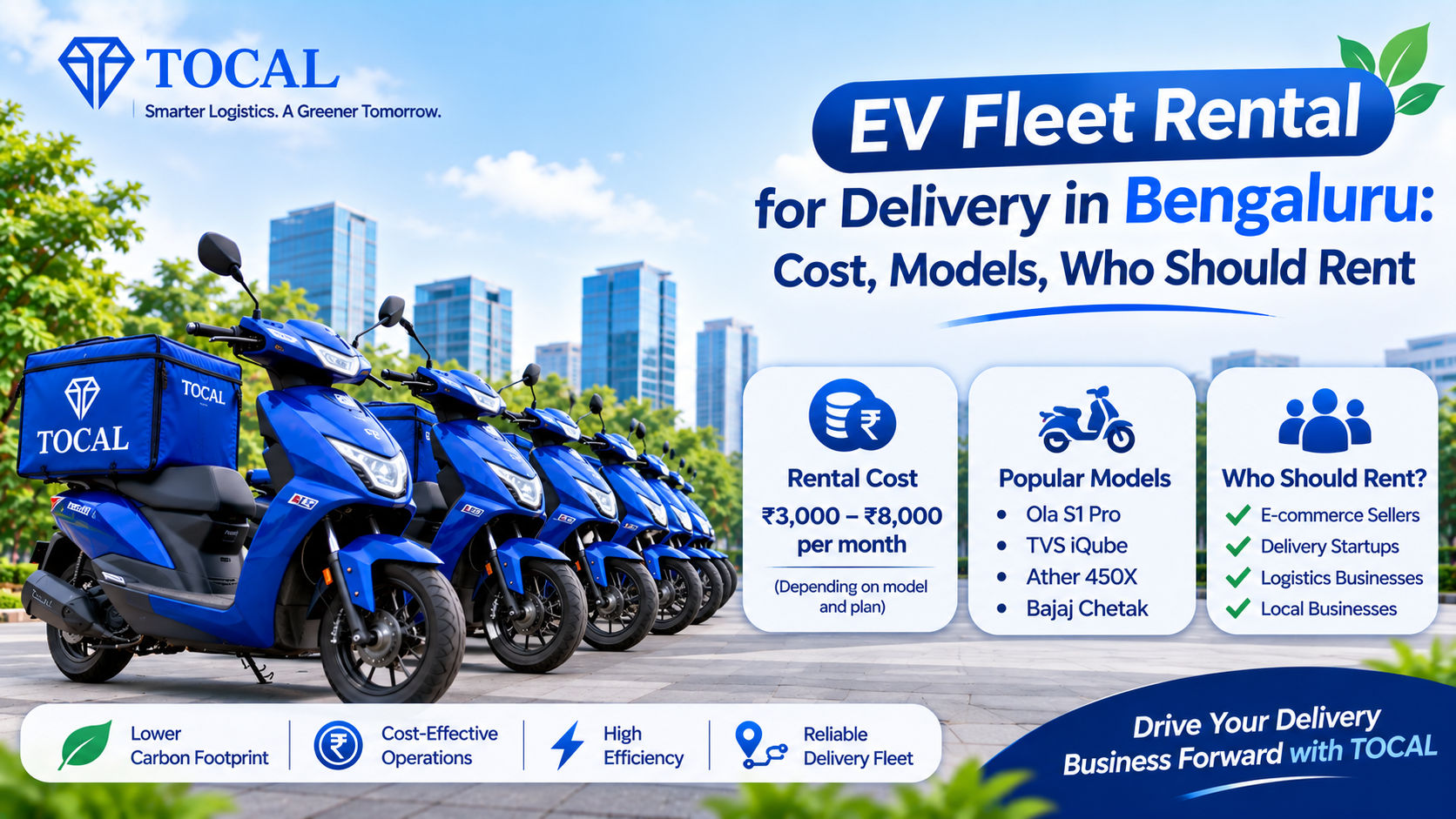
Switching to electric delivery does not mean buying a fleet. EV fleet rental lets businesses in Bengaluru add electric vehicles, and sometimes riders and operations too, for as long as they need them. This guide explains the rental models, what drives cost, who should rent and what to check before you sign.
Quick answer
What is EV fleet rental for delivery, and who should use it? EV fleet rental lets a business use electric delivery vehicles for a set period without buying them, with or without riders, maintenance and charging support depending on the provider. It suits growing D2C brands, seasonal retailers, SMEs and enterprises piloting EVs, and companies with sustainability goals. Compare offers by total cost per successful delivery, not the monthly rate alone.
Key takeaways
- Renting avoids heavy upfront investment and lets you scale capacity up and down.
- Models range from vehicles only (dry rental) to managed fleets with trained riders and operations.
- Cost depends on vehicle type, tenure, usage and what is included, so ask for a written breakdown.
- Rent if you can manage riders, buy if you have large stable volumes, outsource if you want it all handled.
- The agreement matters: uptime, battery health, insurance, charging and exit terms.
Many Bengaluru businesses want electric deliveries for the cost predictability, the cleaner image and the sustainability reporting. Fewer want to buy vehicles, build charging, hire riders and handle maintenance to get there. Rental turns a capital project into a flexible operating decision.
This guide covers EV fleet rental for delivery in Bengaluru: the models on offer, how to compare costs, who benefits most and how to run a rented fleet well.
What is EV fleet rental?
EV fleet rental means using electric delivery vehicles, typically electric two-wheelers and light electric vehicles, for an agreed period without owning them. Depending on the provider, the package may include:
- Vehicles only, with you supplying riders and handling operations
- Maintenance and servicing, so vehicles stay on the road
- Insurance and documentation support
- Charging arrangements, or guidance on setting them up
- Trained riders and operations, in managed fleet models
Always confirm exactly what is included, since packages differ widely.
EV fleet rental models compared
| Model | How it works | Who manages riders | Best for |
|---|---|---|---|
| Dry rental | You rent vehicles only for a period | You | Businesses with their own rider teams |
| Managed rental (vehicles plus riders) | The provider supplies vehicles and trained riders | Provider | Businesses that want capacity without hiring |
| Short-term or seasonal rental | Extra vehicles for a campaign, sale or festive period | Either | Retailers and brands with predictable peaks |
| Long-term lease or subscription | Vehicles on a longer commitment, often at a lower monthly rate | You or provider | Steady operations wanting predictable costs |
| Outsourced EV delivery | The partner runs deliveries end to end on its own EV fleet | Provider | Brands that want results, not fleet management |
| Buy (for comparison) | You purchase vehicles and run everything | You | Large, stable volumes with in-house fleet capability |
What drives EV fleet rental cost
Rental pricing varies by provider, so there is no single rate to quote. These are the factors that move cost:
- Vehicle type and specification: range, carrying capacity and features
- Rental period: short-term rentals usually cost more per month than long-term commitments
- Number of vehicles: larger fleets may qualify for better terms
- Usage: daily distance and shift patterns, and any usage limits
- What is included: maintenance, insurance, replacement vehicles and charging support
- Riders and operations: included or not
- Peak premiums: availability and pricing can tighten during festive seasons
- Deposits, damage rules and exit terms
How to compare offers: total cost per delivery
A low monthly rate can hide costs that arrive later. Compare with:
Cost per successful delivery = (rental + charging + maintenance and insurance not included + rider cost + management and supervision effort + cost of vehicle downtime) ÷ orders delivered successfully.
| Factor | Rent (dry) | Managed rental / outsourced | Buy |
|---|---|---|---|
| Upfront capital | Low | Low | High |
| Flexibility to scale | High | High | Low |
| Rider management | You | Provider | You |
| Maintenance burden | Depends on the contract | Provider | You |
| Battery and technology risk | Mostly provider, check terms | Provider | You |
| Control over operations | High | Shared, SLA-driven | Highest |
Who should rent an EV delivery fleet?
| Business type | Why renting suits them |
|---|---|
| Growing D2C brands | Capacity can grow with orders, without locking in capital |
| Retailers with seasonal peaks | Add vehicles for festive and sale periods, then scale back (see peak season delivery planning) |
| SMEs and individual sellers | Avoid large upfront costs, and test electric delivery at small scale |
| FMCG distributors and retailers with their own rider teams | Swap petrol vehicles for EVs without changing how riders are managed |
| Enterprises piloting electric delivery | Prove the model in a few zones before committing further |
| Businesses with sustainability goals | Lower delivery emissions quickly (see how EV fleets support sustainability goals) |
When renting may not be the right fit
- Very large, stable volumes with in-house fleet capability: buying may offer lower long-run cost and more control
- Very small or irregular volumes: a shared or on-demand delivery partner may be simpler than running even a small rented fleet
- No capacity to manage riders: a managed rental or outsourced EV partner is a better match than a dry rental
- Long routes beyond EV range: make sure the vehicles suit your distances, or limit use to city zones
Rent, buy or outsource: six questions to decide
- How stable are my volumes? Stable and large leans towards buy or long-term lease; variable leans towards rent
- Can I hire, train and manage riders? If not, choose a managed model
- Do I have somewhere to charge and service vehicles? If not, choose a provider that handles it
- How fast do I need to scale? Rent or outsource for quick changes in capacity
- What is my appetite for capital spend and technology risk? Low appetite favours rental
- Do I need SLAs and reporting? Outsourced partners usually come with them (see last-mile delivery SLAs)
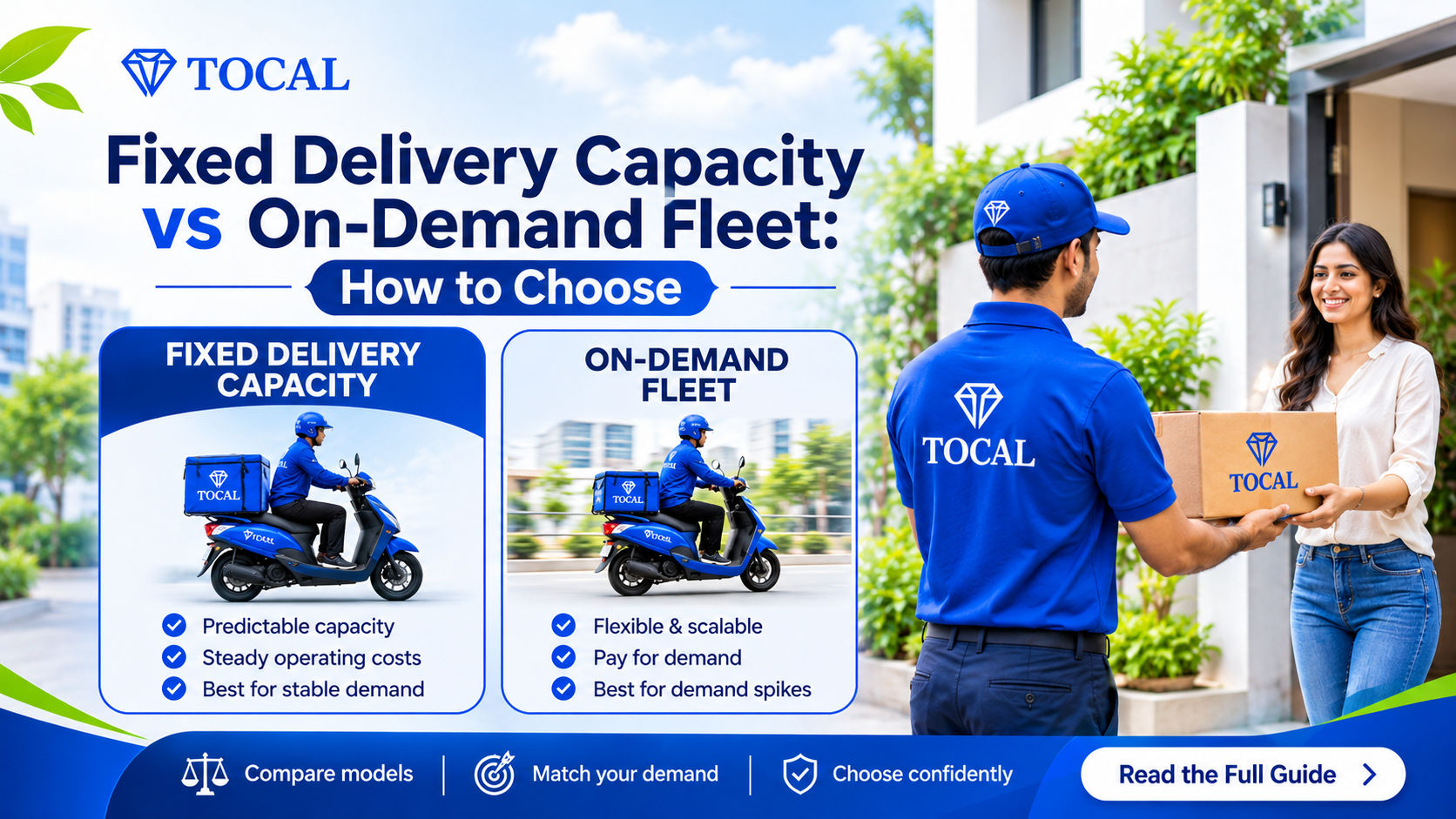
For capacity planning across these options, read fixed delivery capacity vs on-demand fleet support.
What to check in an EV fleet rental agreement
- Vehicle specifications and range that match your daily routes
- Battery health and replacement terms, including what happens if range drops
- Maintenance schedule and uptime commitments, with replacement vehicles when one is out of service
- Insurance and liability: what is covered, and who is responsible for accidents and damage
- Charging: who provides it, where, and at what cost
- Tenure, minimum commitment and exit terms, including how you can scale up or down
- Damage and wear rules, deposits and return conditions
- Documentation and compliance: vehicles properly registered with papers in order
- Riders and training, if included, plus safety gear
- Data and tracking: access to vehicle and trip data for your reporting
Running a rented EV fleet well
Charging and range
Plan charging at your hub, store or a partner site, and schedule it in quiet periods. Design routes and shifts within comfortable range, since slow traffic and detours add distance. Smart planning helps, as covered in rider allocation and dispatch.
Riders and safety
Whether you hire riders or the provider supplies them, train them on electric vehicle basics, charging safety and wet-weather riding. See delivery partner training, safety and earnings and monsoon and traffic in Bangalore.
Zones and hubs
EVs work best on short, frequent trips in fixed zones with stock nearby. Pair them with hubs and fulfilment centers close to demand.
Reporting
Track deliveries, distance and downtime so you can show results and report emissions credibly (see green logistics in Bengaluru).
Using rentals for peak seasons and growth phases
Rental shines when demand is lumpy. A sensible structure:
- Base: dedicated riders and vehicles for your steady daily volume
- Flexible layer: short-term rented EVs, with or without riders, for sales, festive weeks and growth phases
- Overflow: shared on-demand riders for rare, unplanned spikes
Book flexible capacity early, because availability can tighten when many businesses peak together.
EV fleet rental in Bengaluru: local factors
Bengaluru is well suited to electric delivery. Orders cluster in dense neighbourhoods such as Koramangala, HSR Layout, Indiranagar and Whitefield, trips are short and stop-start, and hubs can sit close to demand. Congestion on corridors like ORR and sudden rain add range and safety considerations.
- Keep trips short and zones fixed so vehicles stay within range
- Plan charging near hubs to avoid dead time
- Build rain and traffic buffers into routes and shifts
- Choose a provider that can support you locally with servicing and replacements
Read more in our guide to the EV delivery fleet in Bengaluru.
Questions to ask an EV fleet rental provider
- Which vehicles do you offer, and what range and load do they handle in real city use?
- What is included: maintenance, insurance, charging, replacement vehicles, riders?
- What are your uptime commitments, and what happens when a vehicle fails?
- How do you handle battery health and replacement?
- What are the minimum commitment, scaling and exit terms?
- Can you support peak-season demand with advance booking?
- What reporting and data will I get for deliveries, distance and downtime?
Common mistakes when renting an EV fleet
- Comparing only monthly rates, and ignoring charging, downtime and rider costs
- Choosing vehicles that do not match daily distance and load
- No charging plan, leaving riders waiting or running low
- Skipping rider training on electric vehicle use and safety
- Leaving peak booking too late
- Unclear damage and insurance terms that cause disputes later
How to start in 6 steps
- Map your routes and volumes by zone, distance and time of day
- Choose a model: dry rental, managed rental or outsourced EV delivery
- Shortlist providers and request written breakdowns of cost and inclusions
- Plan charging and servicing before the first vehicle arrives
- Pilot in one or two zones and track on-time rate, downtime and cost per delivery
- Review and scale based on the data. For the wider picture, see how to scale daily deliveries without extra complexity
How TOCAL helps with EV fleet rental and EV delivery in Bengaluru
TOCAL offers EV fleet rentals for sustainable delivery in Bengaluru, and also runs an EV-only delivery fleet with trained delivery partners for businesses that would rather have deliveries handled end to end. Our approach follows three steps:
- Understand: we analyse your order volumes, routes, delivery zones and SLA requirements
- Deploy: we put the right fleet, trained delivery partners and operations team in place
- Manage, track and scale: we monitor performance live and scale capacity up or down as your volumes change
With 98%+ on-time delivery, 30 lakh+ green deliveries completed and 35+ brands served, TOCAL supports D2C brands, retail and FMCG, SMEs and individual sellers and enterprises and quick commerce, through hyperlocal delivery, last-mile delivery, fulfilment centers and EV fleet rentals.
Frequently asked questions
What is EV fleet rental for delivery?
EV fleet rental lets a business use electric delivery vehicles for a set period without buying them. Depending on the provider, the arrangement may cover vehicles only, or vehicles together with riders, maintenance, charging support and operations.
How much does EV fleet rental cost in Bengaluru?
Cost depends on vehicle type, rental period, number of vehicles, usage, what is included such as maintenance, insurance and charging, and whether riders are provided. Compare offers by total cost per successful delivery rather than the monthly rate alone, and ask providers for a written breakdown.
Should I rent, buy or outsource my EV delivery fleet?
Buy if you have large, stable volumes and in-house fleet capability. Rent if you want flexibility and lower upfront cost but can manage riders. Outsource to an EV-only delivery partner if you want vehicles, trained riders, tracking and operations handled for you.
What is the difference between dry rental and a managed fleet with riders?
A dry rental provides vehicles only, and you supply and manage the riders. A managed or wet arrangement also provides trained riders and operational support, so you pay for deliveries or capacity rather than just vehicles.
Who should rent an EV delivery fleet?
Growing D2C brands, retailers with seasonal peaks, SMEs and enterprises piloting electric delivery, FMCG distributors with their own rider teams, and businesses with sustainability targets that want to switch without heavy upfront investment.
What should be in an EV fleet rental agreement?
Check vehicle specifications and range, battery health and replacement terms, maintenance and uptime commitments, replacement vehicles, insurance and liability, charging arrangements, tenure and exit terms, minimum commitments, damage rules and whether riders and training are included.
Can I rent EVs only for festive or peak seasons?
Yes. Short-term rentals let you add vehicles, with or without riders, for sales and festive periods and scale back afterwards. Book early, because capacity can be limited when many businesses peak together.
Does TOCAL offer EV fleet rentals in Bengaluru?
Yes. TOCAL offers EV fleet rentals for sustainable delivery in Bengaluru and also runs an EV-only delivery fleet with trained delivery partners. Share your volumes, zones and requirements and TOCAL will recommend the right model for your business.
Final thoughts
EV fleet rental turns electric delivery from a capital project into a flexible choice. Pick the model that matches how much of the operation you want to manage, compare total cost per successful delivery, read the agreement carefully and pilot before you scale. For many Bengaluru businesses, it is the fastest and lowest-risk way to move to electric.
Thinking about EV fleet rental in Bengaluru? Share your volumes, routes, service areas and requirements, and TOCAL will recommend the right rental or delivery model for your business. Talk to a TOCAL Delivery Expert.