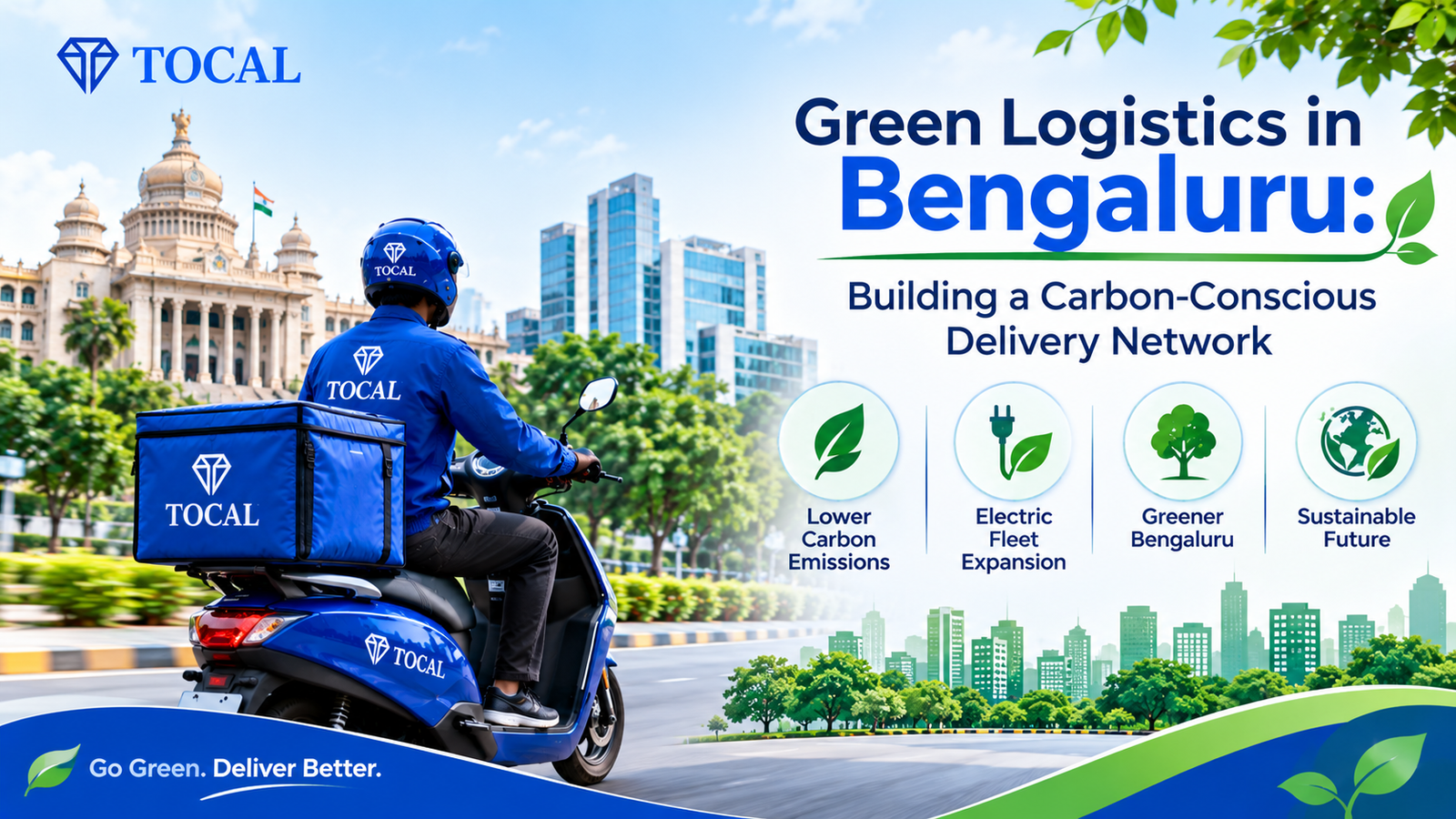
Going green in logistics is bigger than switching vehicles. A carbon-conscious delivery network cuts emissions at every step: cleaner vehicles, shorter distances, fewer wasted trips, smarter packaging and honest measurement. Here is a practical blueprint for building one in Bengaluru.
Quick answer
How do you build a carbon-conscious delivery network in Bengaluru? Combine seven building blocks: an EV fleet, hubs close to customers, zone-based routing and order clustering, higher first-attempt delivery success, right-sized packaging, efficient returns and clean charging. Then measure deliveries, distance and emissions with a stated method, and report honestly. Cutting distance and wasted trips matters as much as the vehicle type.
Key takeaways
- Green logistics is a network design problem, not just a vehicle choice.
- The cleanest kilometre is the one you never drive: shorten distance and avoid repeat trips.
- EVs remove tailpipe emissions; hubs, zones, packaging and returns cut the rest.
- Measure with a baseline and a clear method, and avoid vague green claims.
- Many green steps also lower cost, because wasted trips and returns are expensive.
Bengaluru's deliveries happen in some of India's busiest streets. Thousands of short trips every day mean the way a network is designed, not only the vehicles in it, decides how much fuel, time and emissions each parcel carries with it.
This guide explains green logistics, what a carbon-conscious delivery network looks like, the building blocks to put in place, how to measure progress and how to avoid greenwashing.
What is green logistics?
Green logistics is the practice of planning and running transport, storage, packaging and returns so they cause less environmental harm. In delivery, that mainly means reducing greenhouse gas emissions, wasted distance, packaging waste and failed or repeated trips.
What is a carbon-conscious delivery network?
A carbon-conscious delivery network is a delivery setup that is designed, run and measured to keep emissions low across the whole flow from stock to doorstep and back. It treats emissions as a design input, alongside speed, cost and service quality.
| Lever | What it changes | Example action |
|---|---|---|
| Vehicles | Emissions per kilometre | Move deliveries to an EV fleet |
| Distance | Total kilometres driven | Hubs near demand, fixed zones, clustered orders |
| Utilisation | Drops per trip | Route clustering and well-planned capacity |
| Failed deliveries | Repeat trips | Address validation, live updates, first-attempt focus |
| Packaging | Material waste and parcel volume | Right-sized, protective, minimal packaging |
| Returns | Reverse trips and wasted stock | Fewer avoidable returns, efficient pickups |
Why green logistics matters in Bengaluru
- Dense, congested streets: short, stop-start trips burn more fuel per parcel with combustion vehicles and affect the neighbourhoods they pass through
- Customer expectations: shoppers increasingly notice and prefer brands that act on sustainability
- Reporting pressure: deliveries by a logistics partner usually fall under Scope 3 emissions, which investors and large customers increasingly ask about
- Business logic: shorter distances, fewer failed deliveries and fewer returns reduce cost as well as emissions
7 building blocks of a carbon-conscious delivery network
1. An EV fleet for last-mile trips
Electric vehicles remove tailpipe emissions and suit short, frequent city trips. This is the most visible step, and a strong foundation. Read more in our guides to the EV delivery fleet in Bengaluru and how EV fleets support sustainability goals.
2. Hubs and fulfilment centers close to customers
Distance drives emissions and cost. Placing fast-moving stock in fulfilment centers near dense demand zones shortens every trip. See our guide to micro-fulfilment centres in Bengaluru.
3. Zone-based routing and order clustering
Fixed zones let riders learn their areas, and clustered orders mean more drops per trip. Together they reduce kilometres per parcel, which helps both emissions and speed.
4. Higher first-attempt delivery success
Every failed delivery means another trip. Address validation, proactive customer updates and real-time delivery tracking raise first-attempt success and cut wasted kilometres.
5. Right-sized, protective packaging
Oversized packaging wastes material and space, and weak packaging causes damage and replacements. Right-sizing and protecting products reduces both waste and repeat deliveries.
6. Smarter returns and exchanges
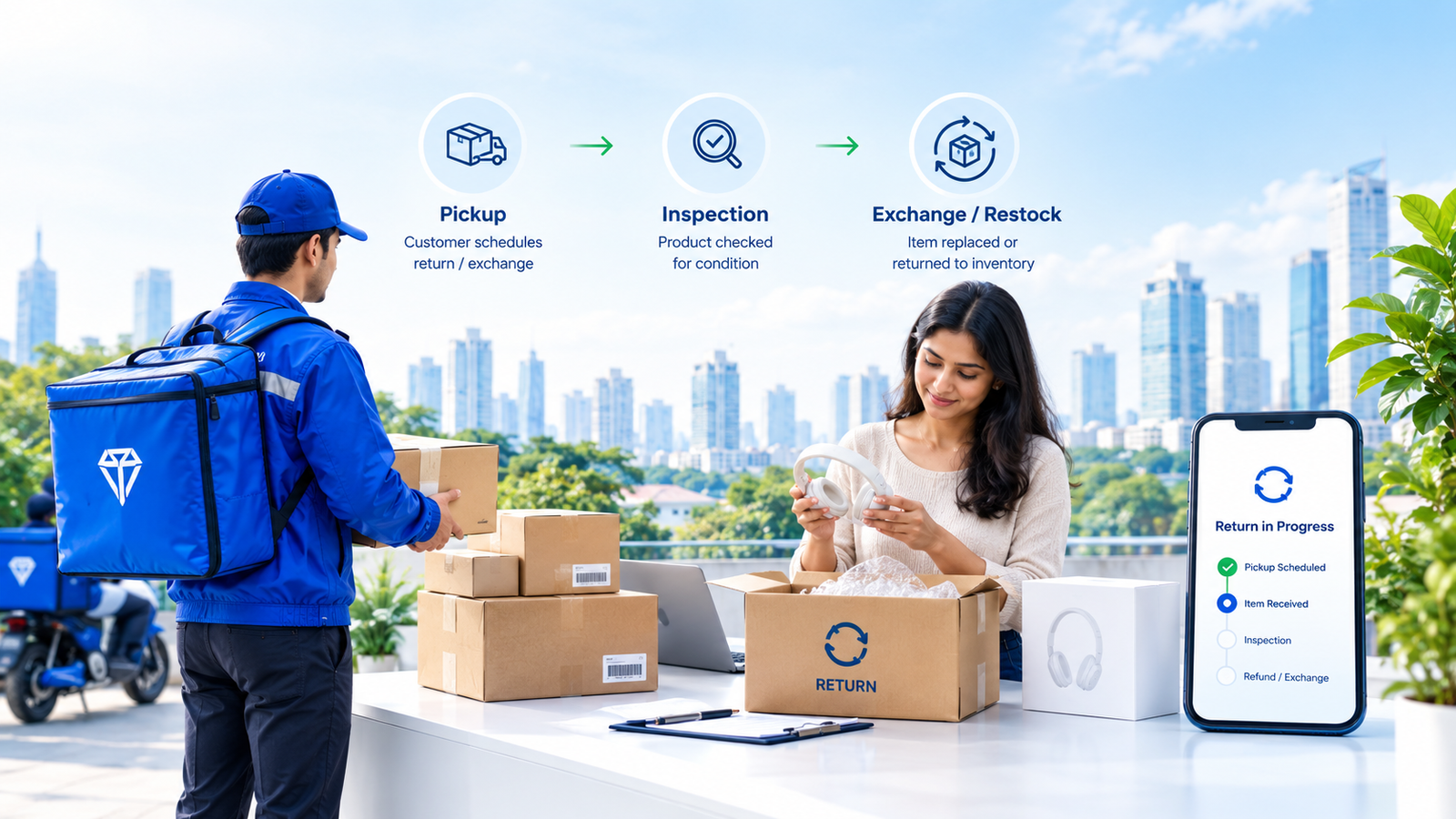
Returns add reverse trips and often wasted stock. Reducing avoidable returns, clustering pickups and pairing exchanges with forward deliveries cut extra distance. Our guide to reverse logistics for ecommerce shows how.
7. Cleaner charging and responsible battery care
An EV fleet's footprint also depends on the electricity used to charge it and on how batteries are maintained and eventually handled at end of life. Where possible, charge using cleaner electricity, plan charging efficiently and work with partners who manage batteries responsibly.
The cleanest kilometre is the one you never drive.
How to measure your delivery network's carbon impact
Credible green claims start with a baseline and a clear method:
- Set a baseline: deliveries, distance and vehicle types for a representative period
- Choose emission factors: use recognised factors for each vehicle type and for electricity
- Calculate: estimate emissions as distance multiplied by the emission factor for each vehicle type, then compare with the baseline
- State your boundary: what is included, such as delivery trips only, or trips plus returns and packaging
- Track over time: review changes monthly or quarterly and report the method alongside the numbers
Frameworks such as the GHG Protocol treat outsourced transport and distribution under Scope 3. Ask your delivery partner for consistent, documented data to support your reporting.
Useful metrics to track:
- Share of deliveries completed by EV
- Kilometres per delivered order
- Orders per trip
- First-attempt delivery success and failed delivery rate
- Return rate
- Estimated emissions per delivered order, with the method stated
How to avoid greenwashing
- Be specific: "X% of our Bengaluru deliveries are completed by electric vehicles" beats "eco-friendly delivery"
- Show your method: explain the baseline, factors and boundary
- Be honest about limits: electricity source, battery production and distance still matter
- Do not overstate: avoid "zero-carbon" claims unless they are fully supported
- Keep improving: publish targets and update progress
A phased roadmap to a carbon-conscious network
| Phase | Focus | Key actions |
|---|---|---|
| 1. Baseline | Know where you are | Collect deliveries, distance and vehicle data; map zones and returns |
| 2. Quick wins | Cut waste fast | Improve address data, raise first-attempt success, right-size packaging |
| 3. Network redesign | Cut distance and emissions per km | Move to EVs in core zones, add nearby hubs, cluster routes |
| 4. Report and improve | Prove and sustain progress | Publish metrics and method, review regularly, expand coverage |
Does going green cost more?
Not necessarily. Many of the biggest steps reduce cost as well as emissions: shorter distances, fewer failed deliveries and fewer returns all save money. Vehicle and charging arrangements vary by model, so compare cost per successfully delivered order, including repeat trips, refunds and support effort, rather than assuming a premium. Renting EVs or working with an EV-only partner also avoids heavy upfront investment (see EV fleet rentals).
Common challenges and how to handle them
- Charging access: plan charging at hubs or let an EV-only partner manage it
- Range per shift: design zones and clusters that keep trips within range
- Data gaps: agree a reporting format with your partner from day one
- Peak-day capacity: reserve extra vehicles in advance (see peak season delivery planning)
- Service levels: keep green deliveries accountable with a clear SLA, as covered in last-mile delivery SLAs
What to ask a green logistics partner
- What share of your deliveries in Bengaluru is completed by electric vehicles?
- Can you provide delivery counts and distance data for my reporting?
- How do you reduce distance through hubs, zones and clustering?
- How do you charge vehicles and manage batteries?
- How do you reduce failed deliveries and returns?
- Can you maintain SLAs and capacity on peak days?
How TOCAL helps build a carbon-conscious delivery network in Bengaluru
TOCAL builds dedicated delivery infrastructure in Bengaluru around an EV-only fleet, with fulfilment centers and zone-based operations. Our approach follows three steps:
- Understand: we analyse your order volumes, delivery zones and SLA requirements
- Deploy: we put the right EV fleet, trained delivery partners and operations team in place
- Manage, track and scale: we monitor performance live and scale capacity up or down as your volumes change
With 98%+ on-time delivery, 30 lakh+ green deliveries completed and 35+ brands served, TOCAL supports D2C brands, retail and FMCG, SMEs and individual sellers and enterprises and quick commerce, through hyperlocal delivery, last-mile delivery, fulfilment centers and EV fleet rentals. To understand how each stage works, read the last-mile delivery process from order to doorstep.
Frequently asked questions
What is green logistics?
Green logistics is the practice of planning and running transport, storage, packaging and returns so that they cause less environmental harm, mainly by reducing greenhouse gas emissions, wasted distance, packaging waste and failed or repeated trips.
What is a carbon-conscious delivery network?
A carbon-conscious delivery network is a delivery setup designed and measured to keep emissions low across the whole flow, using electric vehicles, hubs close to customers, zone-based routing, fewer failed deliveries, right-sized packaging and efficient returns.
How can a business reduce delivery emissions in Bengaluru?
Move deliveries to electric vehicles, place stock in hubs near dense demand zones, cluster orders by zone, raise first-attempt delivery success, cut avoidable returns, use right-sized packaging and measure distance and emissions consistently with your delivery partner.
Does shortening delivery distance reduce emissions?
Yes. The cleanest kilometre is the one you never drive. Hubs close to customers, clustered orders and fewer repeat trips reduce total distance, which cuts emissions whatever vehicle type is used.
How do I measure the carbon footprint of my deliveries?
Set a baseline from deliveries and distance by vehicle type, apply recognised emission factors, and track changes over time. Frameworks such as the GHG Protocol treat outsourced transport as part of Scope 3. State your method and boundaries clearly.
How can I avoid greenwashing in logistics claims?
Make specific, measurable claims, such as the share of deliveries by electric vehicle, back them with documented data and methodology, acknowledge limits like grid electricity and battery impact, and avoid vague words like eco-friendly without evidence.
Is green logistics more expensive?
Not necessarily. Many green measures, such as shorter distances, fewer failed deliveries and fewer returns, also reduce cost. Vehicle and charging setups vary, so compare cost per successfully delivered order rather than assuming a premium.
Does TOCAL offer green logistics in Bengaluru?
Yes. TOCAL runs an EV-only delivery fleet in Bengaluru with fulfilment centers and zone-based operations, having completed 30 lakh+ green deliveries for 35+ brands across D2C, retail and FMCG, SME and enterprise segments.
Final thoughts
A carbon-conscious delivery network is built, not declared. Start with a baseline, cut distance and wasted trips, move last-mile deliveries to electric vehicles, right-size packaging, handle returns smartly and measure honestly. Each step lowers emissions, and most also lower cost and improve service.
Want to make your deliveries in Bengaluru greener? Share your expected volumes, service areas and SLA needs, and TOCAL will plan a carbon-conscious delivery setup around your business. Talk to a TOCAL Delivery Expert.