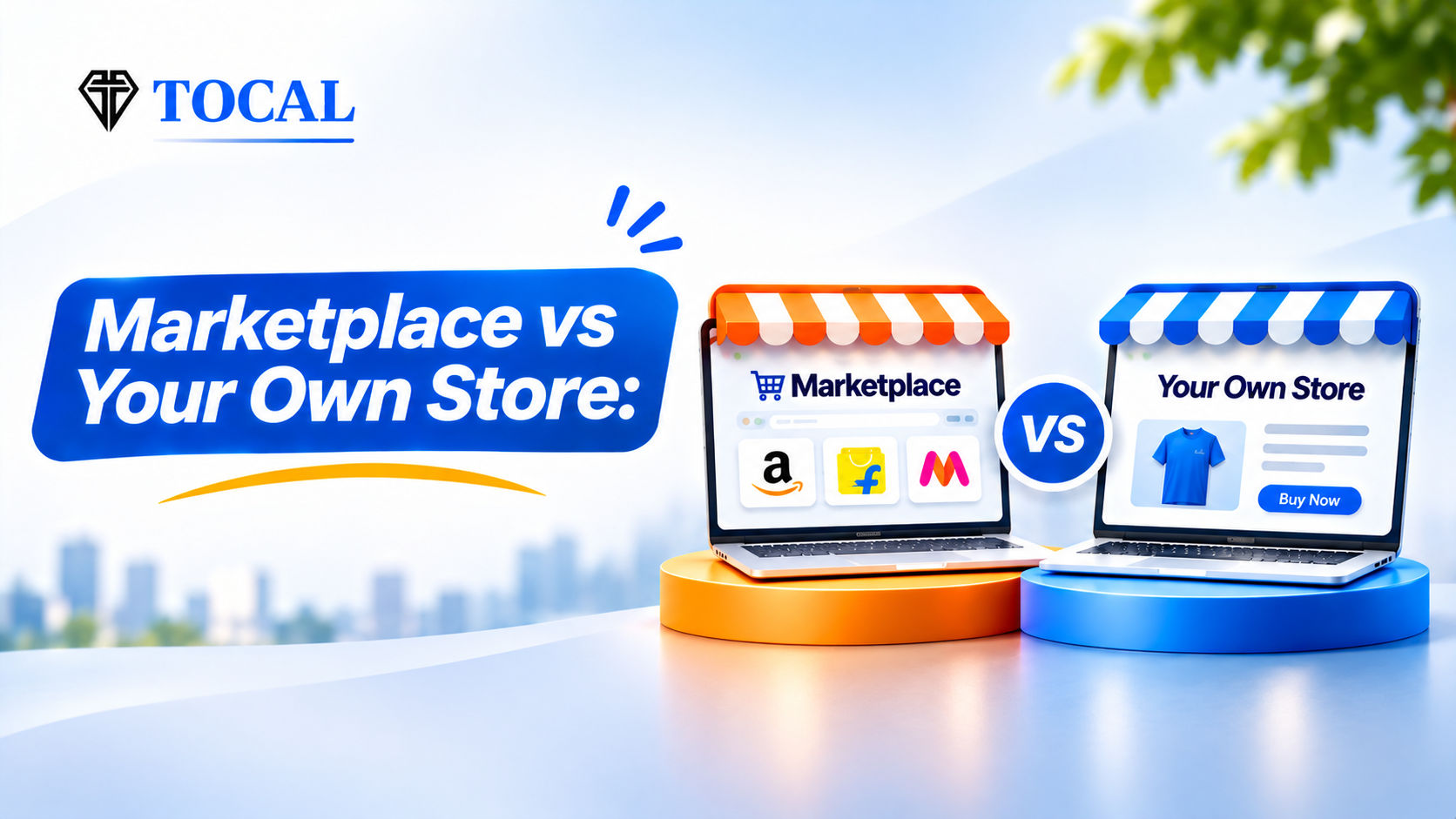
Should you sell on a marketplace, or build your own store? Most small sellers end up asking this, and most focus on traffic and fees. Delivery is just as important: who controls it, who pays for it, who deals with returns and who owns the customer experience. This guide compares how delivery really differs, so you can choose with your eyes open.
Quick answer
How does delivery differ between a marketplace and your own store? On a marketplace, delivery follows the marketplace's rules, standards and sometimes its own logistics, so you trade control for traffic and trust. On your own store, you choose the delivery model, set the promise and charges, control packaging and communication and own the customer relationship, but you must bring your own customers. Many small sellers use both: a marketplace for reach and their own store for brand, margin and repeat orders.
Key takeaways
- The core difference is control: marketplaces set the rules, your own store gives you the choices.
- Marketplaces bring traffic and trust; your own store brings brand, customer data and often better margins.
- Returns, packaging, tracking and delivery promises are mostly decided by the marketplace, but by you on your own store.
- Compare channels by contribution margin per order, not sales alone.
- A hybrid approach often works best, as long as you follow each marketplace's policies.
A new seller lists products on a marketplace and sees orders within days. Another builds her own website and waits weeks for the first customer. The marketplace seller seems to be winning, until she notices low margins, rigid return rules and customers who do not know her brand. The website seller, meanwhile, controls every detail but must handle all the delivery herself.
This guide covers marketplace vs your own store, with a focus on delivery: how each model works, how they compare on cost and control, and how to choose.
The core difference: who controls delivery?
On a marketplace, delivery is a shared responsibility governed by the platform. You may pack and hand over orders, or the marketplace may store and deliver your stock, but the delivery standards, timelines and customer communication are largely set by the marketplace.
On your own store, delivery is yours. You choose how orders travel, what you promise customers, what you charge and how you communicate. That freedom brings work, but it also brings control.
How delivery works on a marketplace
Models differ between marketplaces and change over time, so check the current rules of any platform you use. In general, sellers see three patterns:
- Marketplace-fulfilled: you send stock to the marketplace's warehouses, and it stores, packs and delivers orders
- Seller-fulfilled with marketplace shipping: you pack at your location and the marketplace arranges pickup and delivery through its logistics partners
- Seller-fulfilled to marketplace standards: you deliver using your own arrangements but must meet the marketplace's timelines and rules
In all three, the marketplace typically sets delivery standards and may penalise late shipping, cancellations or poor service.
How delivery works on your own store
- You decide the delivery model: self-delivery, a courier, a delivery partner or a mix (see self-delivery vs courier vs delivery partner)
- You set the delivery promise, cutoffs and slots
- You choose packaging and branding
- You send tracking and updates in your own voice
- You define returns and exchanges
- You handle problems and support directly
If you are starting out, use the delivery setup checklist for beginners.
Marketplace vs your own store: side-by-side comparison
| Factor | Marketplace | Your own store |
|---|---|---|
| Control over delivery | Limited: platform rules and standards apply | Full: you choose the model and promise |
| Delivery promise to customers | Set by marketplace programmes and your listing settings | Set by you, including same-day options |
| Delivery cost | Often bundled into fees, with shipping or fulfilment charges | You pay your delivery provider directly |
| Packaging and branding | Often must follow marketplace guidelines; limited branding | Your own packaging, inserts and unboxing experience |
| Tracking and updates | Mostly sent by the marketplace | Sent by you, in your brand voice |
| Returns and refunds | Policies set largely by the marketplace, sometimes with return fees | Your own policy and process |
| Cash on delivery | Depends on marketplace programmes | Your choice, with your own confirmation steps |
| Customer data and relationship | Mostly held by the marketplace, with rules on contacting buyers | Yours, subject to law and consent |
| Penalties for delays or cancellations | Often defined by the marketplace | You set your own standards and remedies |
| Traffic and trust | Built in; buyers already visit and trust the platform | You must build it through marketing and brand |
| Effort to start | Lower: list and sell | Higher: store, payments, delivery and marketing |
| Peak-season handling | Marketplace sales events bring spikes and strict deadlines | You plan capacity around your own campaigns |
How costs differ
Costs sit in different places in each model.
| Cost layer | Marketplace | Own store |
|---|---|---|
| Selling fees | Commissions and fixed fees by category | None, but store platform and payment fees apply |
| Delivery | Shipping or fulfilment charges, depending on the model | Your delivery provider's charges |
| Returns | Return and reverse shipping charges set by the platform | Your own return and pickup costs |
| Marketing | Often advertising inside the marketplace | Your own ads, content and promotions |
| Packaging | Per marketplace guidelines | Your choice and budget |
| Technology and tools | Included in the platform | Store platform, plugins and tracking tools |
Fee structures change, so use current figures from each platform. To compare channels fairly, calculate contribution margin per order for each:
Contribution margin = selling price − cost of goods − packaging − delivery and fulfilment charges − platform fees and commissions − payment fees − marketing cost per order − returns and RTO allowance.
See the worked example in how delivery costs affect your profit margin.
Customer experience and brand
- On a marketplace, customers remember the platform first and the seller second. You gain trust by association but struggle to stand out
- On your own store, every touchpoint carries your brand: packaging, messages, delivery partner behaviour and follow-up
- Repeat purchases are easier to build when you own the relationship (see how fast delivery improves repeat purchases)
Returns, RTO and cash on delivery
- Marketplace returns usually follow platform policies, which can be strict and may be costly for sellers
- Own-store returns follow your policy, so you can offer exchanges first and tailor rules to your products (see reverse logistics for ecommerce)
- Failed deliveries and RTO are handled differently on each; learn the basics in how delivery companies handle failed deliveries and RTO
- Cash on delivery on your own store needs a confirmation step and a clear remittance process
Which should a small seller choose?
| Your priority | Usually a better fit |
|---|---|
| Get first orders quickly with little effort | Marketplace |
| Build a brand and customer relationships | Own store |
| Control packaging and unboxing | Own store |
| Offer same-day delivery in your city | Own store with a local delivery partner |
| Reach buyers across the country with low upfront cost | Marketplace |
| Protect margins on repeat customers | Own store |
| Test a new product quickly | Marketplace |
| Reduce dependence on one platform's rules | Own store, or both |
Using both: a hybrid strategy
- Use the marketplace for reach and discovery, especially for new products and national buyers
- Use your own store for brand, repeat customers and local speed, with same-day delivery where it makes sense
- Keep stock accurate across channels, to avoid overselling
- Keep packaging and quality consistent, within each marketplace's rules
- Follow each marketplace's policies on contacting customers and promoting your own store. Do not break the rules to redirect buyers
- Compare channel margins quarterly, and shift effort to what earns the most
Delivering your own-store orders in Bengaluru
Your own store gives you something marketplaces find hard to offer a small seller: control over local speed. In Bengaluru, dense areas such as Koramangala, HSR Layout, Indiranagar and Whitefield make same-day delivery realistic when stock is close and riders know the zone. Pair it with a courier for customers elsewhere, routed by pin code.
- Compare hyperlocal delivery vs courier to choose the right service for each pin code
- Plan cutoffs, slots and zones using same-day delivery in Bengaluru for online sellers
- Capture block, tower and landmark details, since many customers live in apartments (see gated community deliveries)
- Plan for rain and peaks (see monsoon and traffic in Bangalore)
Questions to ask before using marketplace fulfilment
- What are all the fees: commission, fulfilment, storage, returns and any penalties?
- What delivery and packaging standards must I meet?
- What happens if I ship late or cancel an order?
- How are returns, refunds and damaged or lost items handled, and who pays?
- When and how do I get paid?
- How is my stock stored and counted?
- Can I use my own packaging and inserts?
Common mistakes
- Judging channels by sales alone, not contribution margin per order
- Ignoring marketplace rules, then facing penalties or account problems
- Launching your own store without a delivery plan
- Depending on one marketplace for everything
- Inconsistent quality across channels, which hurts reviews
- Overselling, because stock is not synced between channels
- Not tracking returns and RTO by channel
How TOCAL helps small sellers with their own store
TOCAL serves SMEs and individual sellers with enterprise-grade logistics sized for their business, built around an EV-only fleet. For own-store orders in Bengaluru, we offer hyperlocal delivery for same-day delivery within the city, last-mile delivery with live tracking and fulfilment centers. Our approach follows three steps:
- Understand: we analyse your order volumes, delivery zones and SLA requirements
- Deploy: we put the right fleet, trained delivery partners and operations team in place
- Manage, track and scale: we monitor performance live and scale capacity up or down as your volumes change
With 98%+ on-time delivery, 30 lakh+ green deliveries completed and 35+ brands served, TOCAL also supports D2C brands, retail and FMCG and enterprises and quick commerce.
Frequently asked questions
How does delivery differ between a marketplace and your own store?
On a marketplace, delivery is usually governed by the marketplace's rules, standards and sometimes its own logistics, so you have less control over timing, packaging and customer communication. On your own store, you choose the delivery model, set the promise and charges and control the whole customer experience.
Is it cheaper to sell on a marketplace or on my own store?
It depends. Marketplaces add layers such as commissions, fees and sometimes shipping or fulfilment charges, but bring traffic. Your own store avoids marketplace fees but you pay for delivery, payments, marketing and technology. Compare contribution margin per order for each channel using your own numbers.
Who owns the customer on a marketplace?
Typically the marketplace controls customer data and communication, and has rules about contacting buyers. On your own store, you own the customer relationship and can communicate directly, within the law.
Who sets return rules on a marketplace?
The marketplace usually sets return windows and conditions, and may charge for returns. On your own store you define your own policy, which you should keep simple and visible.
Can I sell on both a marketplace and my own store?
Yes. Many small sellers use marketplaces for reach and their own store for brand, repeat customers and margin. Keep packaging and quality consistent, split inventory carefully and follow each marketplace's policies.
Which is better for same-day delivery in Bengaluru?
Your own store gives you more control to offer same-day delivery in Bengaluru using a hyperlocal delivery partner, subject to your stock and cutoffs. Marketplace speed options depend on the marketplace's own programmes and rules.
What should I check before using marketplace fulfilment?
Check all fees, delivery and packaging standards, return and refund rules, penalties for late shipping or cancellations, payout timelines, how stock is stored and handled and what happens to damaged or lost items.
Does TOCAL deliver orders for small sellers with their own online store?
Yes. TOCAL serves SMEs and individual sellers with hyperlocal delivery, including same-day delivery within Bengaluru on an EV-only fleet, so own-store orders can be delivered quickly and tracked. Share your volumes and areas and TOCAL will plan a setup sized for your business.
Final thoughts
Marketplaces give you traffic and trust. Your own store gives you control, customer relationships and often better margins. Delivery sits at the heart of the difference: on a marketplace it is a set of rules you follow, on your own store it is a service you design. Compare channels by contribution margin per order, follow each platform's rules and consider using both, with your own store as the home for your brand.
Selling from your own store in Bengaluru? Share your volumes, delivery areas and product type, and TOCAL will plan a delivery setup sized for your business. Talk to a TOCAL Delivery Expert.